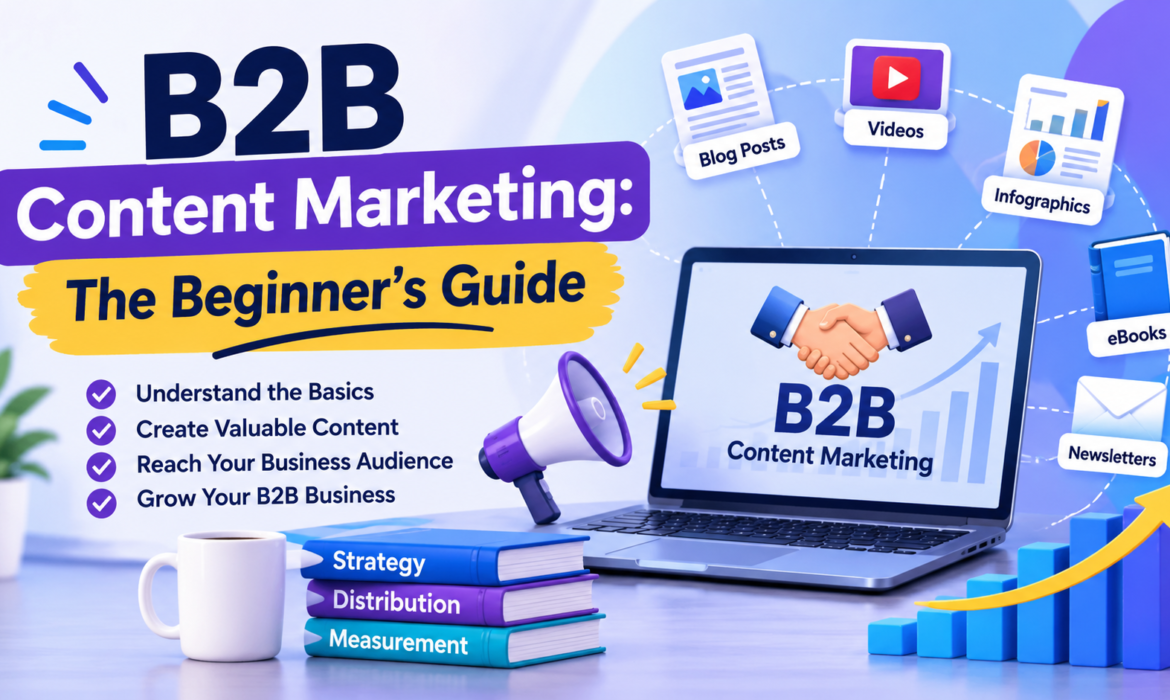
B2B Content Marketing: The Beginner’s Guide
Creating content for the end customers is one thing while creating content for businesses is another. This is what business-to-business (B2B) companies do. They create b2b content marketing for other businesses to build their trust and influence their buying decisions. For instance, a cybersecurity company publishes blog posts and research reports on cybersecurity to attract IT companies looking for reliable security solutions and services.
Similarly, a company offering digital marketing services produces content around SEO and marketing to educate potential customers searching for digital marketing solutions for their businesses. If you are a B2B company struggling to advertise your content to the right audience, this blog is for you.
Why B2B Content Marketing?
B2B content marketing is not very different from conventional content marketing. Unlike traditional brands that promote their content to attract end customers, B2B companies create and distribute content to educate and attract business buyers.
Their primary objective is to convert potential business customers into clients. Hence, B2B content marketing strategies aim to address the challenges faced by businesses rather than simply promoting products.
Effective Ways to Create B2B Content Marketing Strategies
B2B content usually includes whitepapers, case studies, industry reports, blog posts, video interviews and podcasts. Adopting a B2B content marketing strategy does not mean changing your existing content formats.
All you need to do is revise your existing content marketing strategy using the following approaches:
Know Your Target Audience to Target the Right Keywords
If you want to attract other businesses, you must know who your target audience is and what they are searching for on the web. Understand their search behaviour, business challenges and purchasing decisions. As for the keywords, your target keyword list can include a wide range of terms, with commercial, transactional and informational keywords taking priority.

For example, a CRM software can target keywords such as “CRM software pricing comparison”, “best CRM software for small businesses” and “CRM software features”. Including relevant long-term keywords in your content is an effective B2B content marketing strategy.
Make Your Content More Informative and Useful
An experienced B2B content marketing agency understands the importance of creating informative content for your website. Your content should not only include relevant keywords, internal links and real-world examples but also provide accurate answers to user’s queries.
This is how you can improve the organic visibility of your content, by making it more valuable for your target audience than your competitors’ content.
Create and Publish Original Industry Research
Any website can provide generic content. If you want to boost your B2B content, you need to go the extra mile by incorporating original research into your content.
This is an effective way to include first-hand insights and hence, uniqueness to your published report. Besides, conducting surveys and including expert opinions in your content, you can further improve its relevance for other industry professionals.
Build Your Own Email Newsletter
One of the most effective B2B content marketing services is creating an email newsletter to engage with your existing and potential customers. What should these emails include? Promotional offers? Not necessarily.
You can use your newsletter to share recently published content with your audience based on their interests and preferences. Likewise, you can share important industry updates, useful insights and product details with your subscribers.
Dive into LinkedIn Marketing
LinkedIn should, without a doubt, be an integral part of your B2B content marketing strategy. Wondering why? Ask why not? Because LinkedIn, unlike many other social media platforms, focuses on building professional networks and business connections.

Hence, it is the right platform to share your company updates, educational posts, case studies, industry insights and expert opinions with potential business customers.
Repurpose Existing Content
Why spend more time and energy creating new content from scratch when you can repurpose your existing content? Content repurposing allows reuse of existing content into multiple formats. To learn how to effectively repurpose your content, read this article.
You can then share this repurposed content across different platforms to reach a wider audience. For example, you can convert a detailed blog on types of SEO services into social media posts, short videos or infographics.
Expand Content Outreach with Video Marketing
If you are relying only on text-based content for your B2B content marketing strategy, now is the time to incorporate video-based marketing into your marketing mix. Why? Because videos help simplify complex topics, making information easier to understand.
You can start with creating expert interviews, customer testimonials, product demos and educational tutorials for your audience. And guess what? You don’t need to create new video content from scratch. You can repurpose existing blogs into short videos, saving both time and effort.
Steps to Build an Effective B2B Content Marketing Strategy
Creating an effective B2B content marketing strategy requires strategic planning and execution. Below are the steps you can follow to improve your chances of attracting more business through your B2B content.
- Start by defining your business goals: Do you know what you want to achieve from your B2B content? Are you looking to generate leads, increase traffic or improve brand awareness?
- Understand your target audience: The more you know about their search behavior and purchase requirements, the better you personalize your content for them.
- Research competitors and keywords: Make targeting relevant keywords and identifying content gaps through competitor analysis your priority.
- Design a content calendar: Plan everything in advance, from content topics to publishing schedules, to organize your workflow and save time but leave enough room for any last minute changes.
- Create valuable content: Hire a trusted B2B content marketing agency to help you create original, accurate and useful content.
- Promote your content: Use reliable B2B content marketing services to distribute your content across search engines, social media platforms and other relevant communication channels.
- Measure performance: Always track important metrics, including website traffic, leads, engagement, conversions and revenue, to ascertain your marketing performance.
End Note
The Internet is flooding with content, so why should your audience read yours? Your B2B content marketing strategy should answer this question. Are you ready to build an effective strategy and kickstart your B2B marketing journey? Reach out to us through our official email address or call us today to book an online or in-person appointment.
Our experienced team of digital marketing experts provides customized B2B content marketing services to both small and enterprise-level businesses. Our job is not limited to optimizing your content. We help you build your brand authority by addressing your business challenges, attracting qualified leads and improving your conversion rates. Connect with us today.
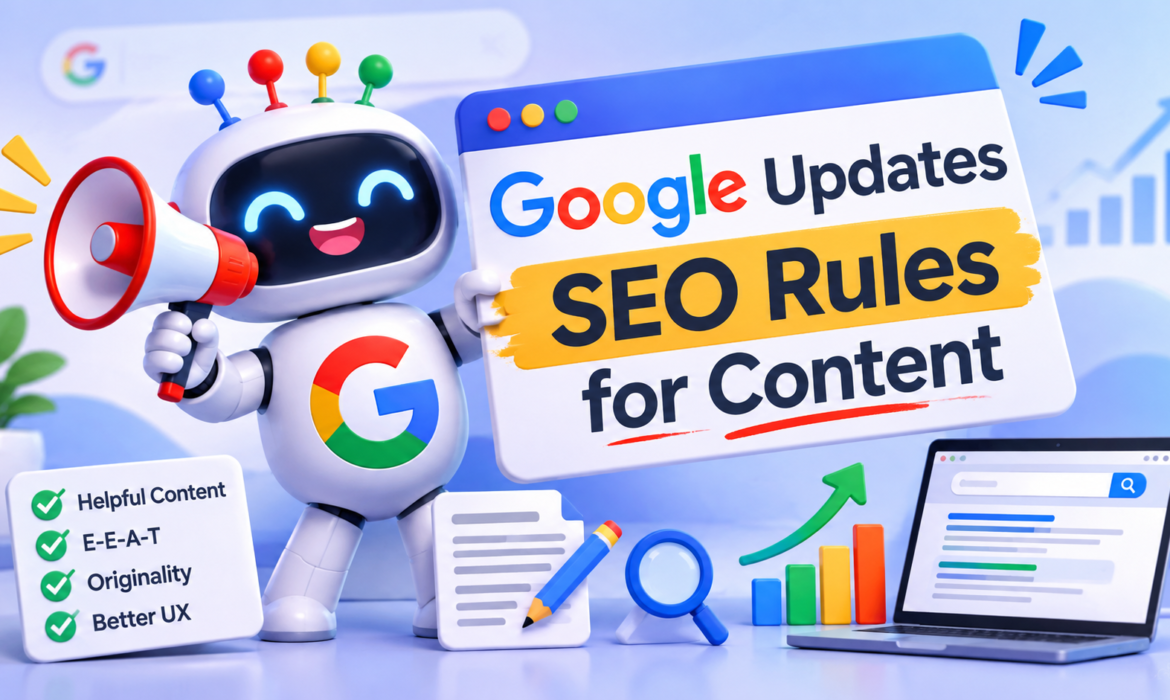
Google Updates SEO Rules for Content
Google keeps making changes to its SEO rules. You can easily ignore them, but that comes with a heavy cost of losing the ranking of your site. You can’t blame the platform for that, because you simply ignored Dumbledore’s warning not to step into the forbidden forest!
Now, you have the first hand lesson of adhering to Google updates, and since you’re on the right path, let me tell you about the new October 2026 update on the usage of creating helpful, reliable and audience-oriented content and on using generative AI content.
Google also started rolling out the 2026 spam update on September 24. Although the rules are short and compact, you get the idea how Google comprehends quality of content. If you are publishing your pieces on the platform, it will work as an important checklist, so you can easily audit your webpages.
The AI Mandate: Check the Content Manually
Yes, I know AI makes writing easier. It’s like waving the wand and you get the thing you wanted. But the fact is spells can go wrong and similarly AI makes mistakes. It has a habit of predicting words without understanding the facts. Thus, the output most of the time comes with free hallucinations.
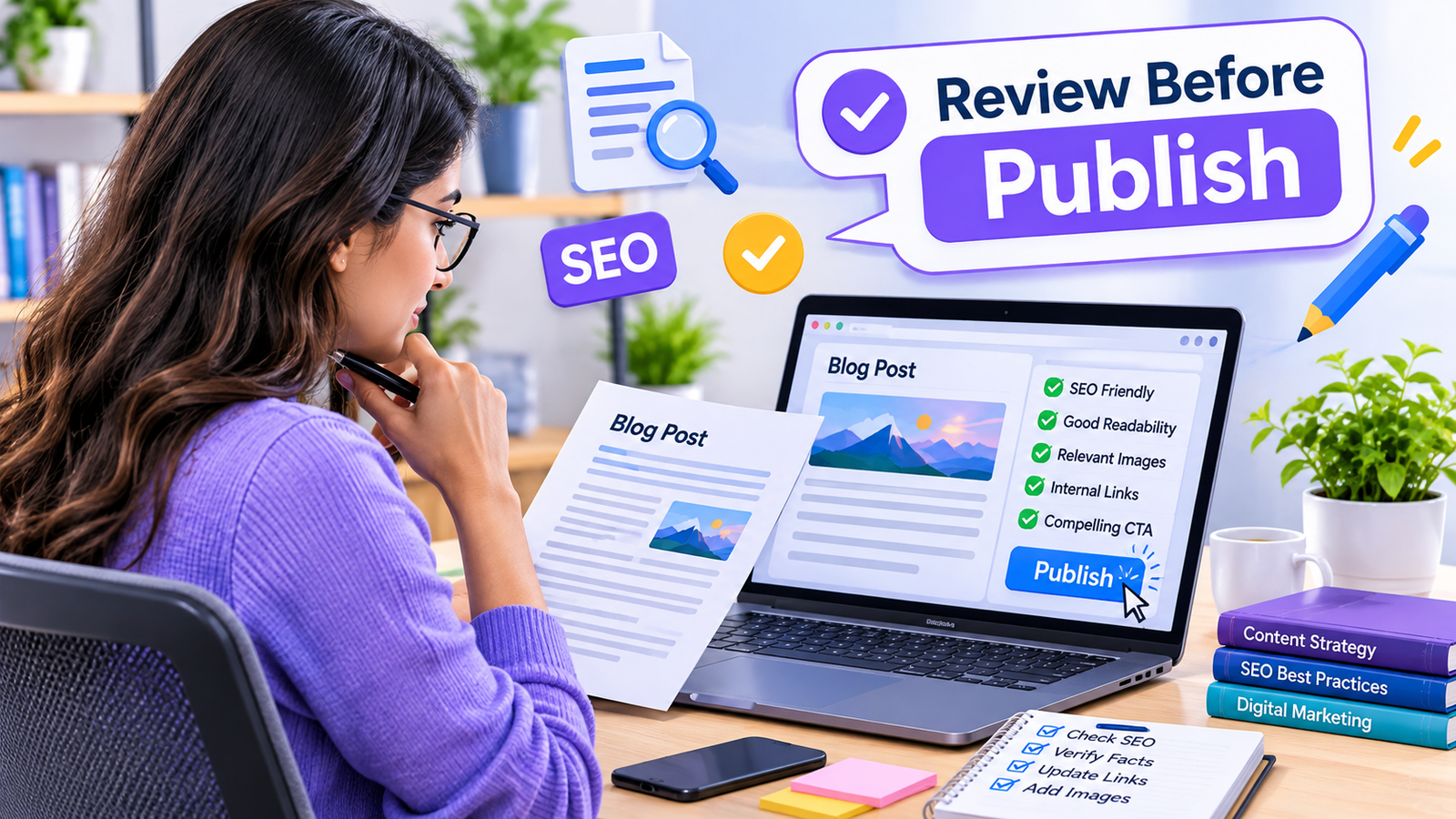
Now, this doesn’t mean you are banned from using your wand, because there’s no penalty for this from Google. The message is that you can use your wand/AI, but you need to check the result before you go on and publish it for your target audiences to see.
I’ve faced a situation with one of my contents. It was on the topic of the latest collection of smartphones, and I needed help regarding some detailed information. So, the AI tool I used for this gave me a list of latest phones, but two of them were from the previous year, and I almost published the content, but then I checked it myself and caught the mistake. If I published it, my customers would have been misled.
Review the Entire Page
Just reviewing the specific content won’t do. Google says, you need to go through the entire page, like the schema, image alt text, meta title, descriptions and the data.
It’s like mugging up just the spells, and not reading what they can do and how to dispel them if anything goes wrong, can be a huge mistake.
In the case of your website, you need to understand that the image alt text talks about the same thing that’s displayed. Schema text must have the same price, detail or rating that’s on the webpage and the meta description and title that’s not filled with promise or extra explanations.
Give Main Content Importance
The main content on your webpage gives your audience the full overview of what it actually offers. The things you need to check are the headings, tabs, tools, media, user contribution and other texts. Some said that Google goes through the headings to see if they are exaggerating the intent of the site.
The best thing you can pull here is to give the trailer before the movie begins. You know how movies work; trailers grab the attention even before they go to the theatre.
Give the answer right at the top of the webpage, it can be a compact text or tool that can help your visitors get the perfect idea. Try not to bury the main concept under long introductions.
Google Notices the Crucial Attributes
Accuracy, expertise, authenticity and effort, these are the four attributes Google pays attention to. These are the things that only a human can provide and AI can’t.
Before you take the AI content as your gospel and publish it, make sure they clarify these four points.
- Accuracy: Whatever you’re publishing must be true and have proper evidence to prove your claim.
- Expertise: Do you really know about the things you’re writing about? If you don’t have the exact information regarding that topic, Google might frown a bit. Not really, but your customers will go somewhere else.
- Effort: How much effort are you putting in your webpages, counts. Just putting on the page what your AI pal told without giving an effort of checking what actually works can put your site at a huge risk.
- Authenticity: Your content must be original. It has to be informative that your customers will not get from somewhere else. If you copy and paste the same format, your audiences will not choose you.
An article you worked so hard on will fall short if it provides the same information as everyone else. The quickest fix is to put a detail that only you can offer.
For my website, I added some specific information that’s only exclusive to our business, others don’t offer the same. So, where’s your Snitch? Find it and put it there to draw more customers.
Avoid Mentioning Fake Authors
“Deceptive authorship,” this is a thing Google continuously flags. Remember Alastor Moody? How Barty Crouch Jr. faked him and made Harry believe he actually meant well? At the end his disguise was exposed, and he had to return to Azkaban.
When it comes to your website, faking names of authors, made up biographies signifies low quality content. Like Harry Potter, Google might not identify the deception immediately, but if anyone tries to verify them and finds out, it can be an issue.
So, skip the polyjuice potion, and put real person’s name, their bio, headshots and their true credentials to keep things honest.
Bulk Content without Real Insight is Problematic
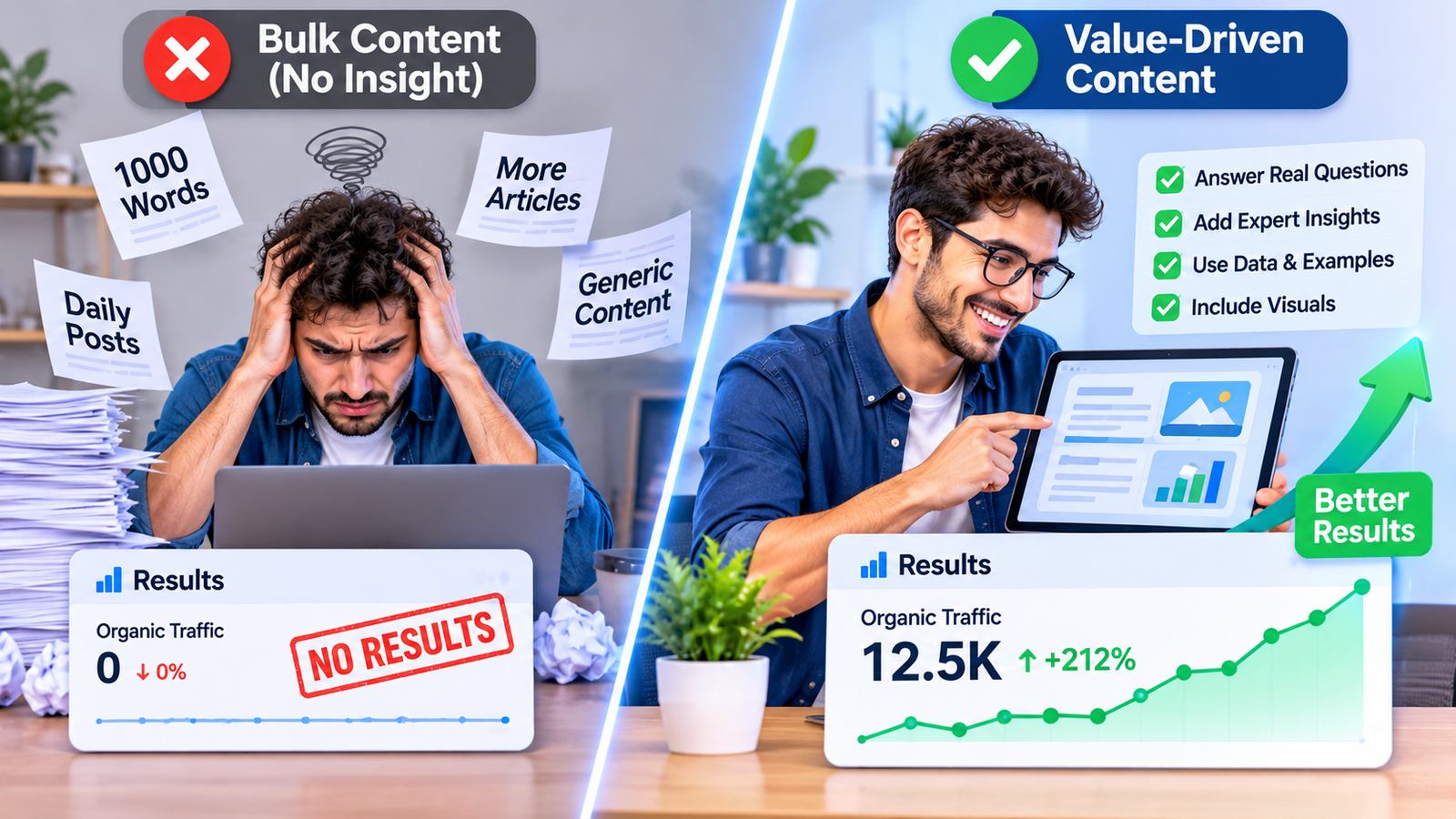
Publishing content in bulk each month, without real insights is a major flag. And it can downgrade your website on the search results.
The best example for this is, adding different cities where you provide services and copy pasting the same detail on each page, just altering the city name.
Before putting the content online, ensure the pages have something different to offer. If it’s a different city, then it must have that place specific information, such as pricing, details of the team serving there and local case studies.
A client came to me with a similar issue and I fixed it by adding details about the cities they serve, unique information that’s available in that city only, etc. These audits helped them regain a higher rank than before.
Fake Updates isn’t Proper
Take the content that you wrote in 2025 and you just changed the date and detail to 2026, will it work? NO. Real update means accuracy, media, examples, structure and usefulness.
In 2026 the process you mentioned might have some new ways, or someone has explained a different way. You have to research a bit and update the same.
When it Comes to Content Keep Things Transparent
Google checks the content quality based on who wrote it, why and how. This doesn’t signify you have to put a disclaimer on every page. Check what the content is about, if it’s research-based, a review or something that helps your audience to make their buying decision.
After that, put a short note about how AI helped framing the content and how a person checked the entire thing for accuracy. This can build trust.
Final Thoughts
Google updates isn’t going to punish you for using AI, all it asks from you is to review the content for its authenticity, honest claims and real updates. Use AI for speed, then add real human knowledge before you publish them.
And if you’re looking for an SEO company that can do the hard work for you, contact One Design Marketing Technologies. We offer top notch SEO services with PPC services, content marketing services, AI SEO, LLM SEO and more. Call us today!
How to Ensure Visibility in ChatGPT Shortlists and Find Room to Compete
If someone tells you that AI has taken up the market, you’ve got to agree, because it’s true. Now, if it’s bad or good I don’t want to get to that discussion. The point, for so many, mostly customers, is that it has become easier to find what they’re looking for online. From the most famous ChatGPT to Gemini, Google AI Overview, Claude and many more help customers and vendors alike.
A recent survey by B2B marketers on SEMRUSH showed how buying decisions have changed using artificial intelligence.
- 83% buyers said that AI platforms helped them to make the final decision while choosing a retailer.
- 92% customers stated that they found it easy to shortlist sellers of products and services.
- And 97% claimed that they discovered new shops and vendors through AI search.
So the main question here is that is your name in the seller’s list? If it’s not, then you are already running a race you didn’t sign up for.
I conducted an analysis to find a ChatGPT shortlist and use 5 different prompts 20 times to get varied answers. After getting the response I ran a test on it to see the sources and the additional queries on each prompt.
Let’s take a look at how I did it, so you can get an idea about the shortlist you should pick.
What does a ChatGPT Shortlist Mean?
This is a list of potential businesses, pulled from a bigger source of seller’s list. This is what gives you the idea of the best brands out there, so you don’t feel lost searching through an ocean. However, here I’m not actually giving you a list, but showing you the way I did it so you can make your own by giving prompts to ChatGPT.
So, in my research I asked ChatGPT about the best jewelry brands for engagement rings, and through this, I shortlisted 5 to 6 names, so you don’t have to look at 20 names.
I have narrowed down the selection based on categories such as country, design variety and price range. I also categorized them as:
Brand Name: This is the name of the brands, so you can find the desired one, and if you have already heard of a brand already, you might find them here as well.
Design Variety: This section points out the type of collection they have. The column depicted, if they have all readymade designs, customized options, if they only specialize in diamonds or other gemstones, also if they have various metal options.
Best Suitable For: Rings are there, but who fits the best for this brand? That’s what is mentioned in this section. ChatGPT helped me point out if this is for traditional buyers, online shoppers, trendy customers, couples, budget conscious audiences and so on.
Why They Stand Out: Here, you can read about if the brand website has any special features like 360 degree view, try it on, comparison tools, carat size choice, etc.
This is just one prompt that shows you the brands you can choose from and what they are popular for. But there are still challenges when you want to know what type really fits you. The point is when you’re gonna spend money, you must know if it’s totally worth it.
So, here comes the dilemma that AI prompts are not easy to predict. Each try will give you a new answer. Also when you give the same instructions, you still get a different response. This way, you might think this is bonkers! AI has lost its mind! But no, it has no mind at all.
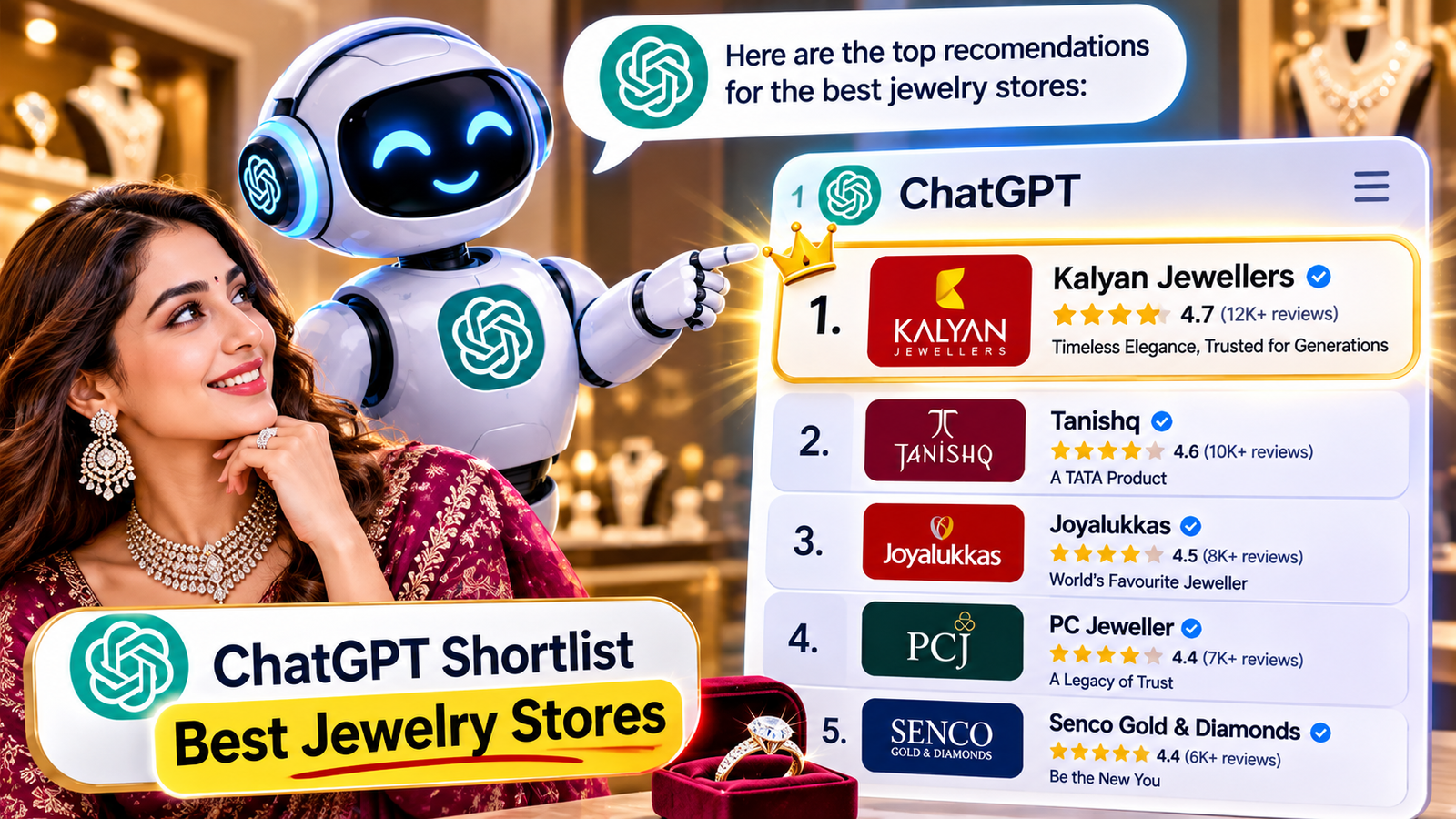
Find the Queries That Creates the Ultimate Selection List
Gone are the days when people just normally typed “diamond engagement rings” and they found some blue links, they clicked on them and found their forever ring. Today, the scenario has changed with AI, as customers give a prompt that eventually starts a conversation, like, “where can I find a marquise cut ring that won’t break the bank?”
It’s just the way a buyer has prompted, therefore it’s impossible for you to understand how they will phrase it. But you can do one thing, that’s reading the response instead. You can ask ChatGPT a customer might ask and then evaluate three points:
- Did the AI platform provide a list?
- Does that list of brands actually include the companies that buyers would consider?
- Does the website offer any special features for buyers?
This way you will easily save time and you’ll get the answer from the list which they will really consider, and the question will be worth monitoring as well.
Test Visibility on Various Topics
When you’re asking just one question, it will not yield a desired response. Why? It’s simple because customers are coming to the query with the same product but their needs are different.
For example, one is looking for natural diamond engagement rings; another is looking for lab-grown and custom choices. Also, one is looking for a famous brand; another is searching for an alternative option. Each of these queries will create many lists, so you just need one question that gives you the answer.
What I did is to categorize in this way:
- Type of Prompt: It can include the best of the best, the overall budget a customer is looking for, alternatives, and if there’s any focused desire.
- What the Customer is Actually Asking: They might want to say, “just tell me the names of the best store,” “which seller suits my budget?” “I already know the names, but is there anyone else like them?” and “I want something special, a specific design that I had in mind.”
- Example Queries: Based on the requirements there will be queries.
The catch here is that AI will not give you the same answer, so it’s important to run the same question multiple times.
Who Finally Gets Included in the ChatGPT Shortlist?
The best thing you can do to get the final result is to ask each question at least 10 times, and use new chat pages each time. Next check how many times every store has appeared in each chat. The big brands will obviously show up in almost each page, while others will be occasional, but bigger doesn’t always mean better.
You’ll see small businesses mentioned as well because they tend to answer specific questions of buyers.
You also have to remember that your brand is listed because AI lists them based on budget, designs and so on. If your company is always mentioned as an affordable brand then it’s a positioning issue, and you need to fix it.
Not Every ChatGPT Shortlist Is the Same
You must have understood by now that AI loves to list the big brand names, and this is what becomes an issue for the smaller and newer brands. The best way to get the alternatives is to check reviews or guide sites. You can look for TripAdvisor, Reddit, Quora and similar places to get the mentions.
Final Thoughts
AI now makes search easier for customers as it narrows down the names to fewer brands. If your company’s name isn’t there, begin with the responses, check the names, how the platform is depicting them and find a way where you can start competing.
Also, if you’re looking for the top rated SEO company for the best SEO services, One Design Marketing Technologies is the one stop solution. We offer PPC services, content marketing services, content writing and AI SEO services, so you find everything under one roof. Contact us today!
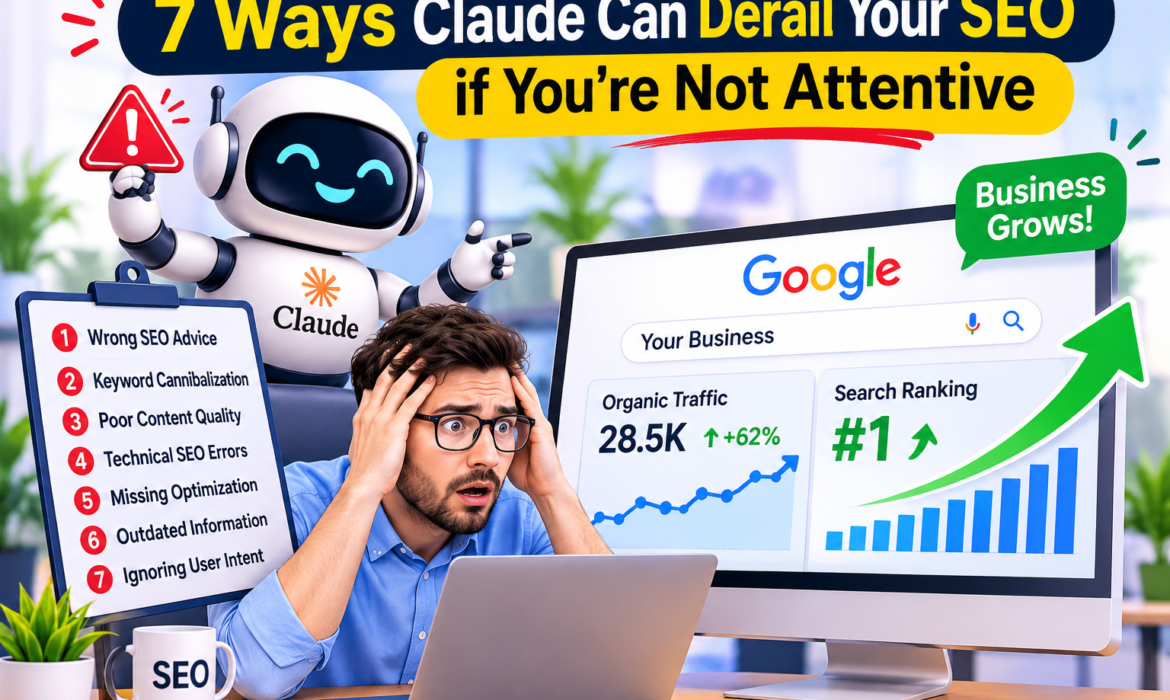
7 Ways Claude Can Derail Your SEO if You’re Not Attentive
Artificial intelligence is an everyday companion of us now. Whether we need to buy a hand cream or a pair of earrings, AI platforms such as ChatGPT, Claude, Copilot and others are there to serve you. And when it comes to search engine optimization, no matter who you ask, one will tell you it’s the beginning of a new chapter and the other might tell you it’s the end of SEO.
But after all these years of working in this field, I consider that both opinions aren’t quite right. AI is actually very helpful, it’s a blessing in disguise; like professor Snape seemed bad but later turned out he always protected Harry! AI is similar, I mean yes it can read a crawl document within seconds, draft an article within minutes and sort millions of keywords and more in literally no time.
However, it’s not all goody two-shoes at all times either, because simple and almost invisible mistakes can cost you the top rank you achieved after many tries. And the scary part about those mistakes is they arrive with a convincing look, so you fall for the trap anyway, just like Tom Riddle!
The issue isn’t that AI sucks at SEO. The problem is that it is fully unaware of your brand website, its objectives or history. In this blog, let’s read about the seven points where AI almost slips out of your hand, but I tell you how to catch it every time, just like a princess always landing in the prince’s arms!
Claude Finds Nonexistent Problems
Give Claude a crawl export which is basically a downloadable file and prompt it to find the issues and give you a clean list of it. You will find some of the real problems, but not all of them are correct. It’s possible it might tell there’s JavaScript on a simple HTML site. Now, if you take this suggestion word by word, it might get you into trouble.
If you end up passing the problems and send it to your client, when they find out the flaw, you might lose credibility. So, it’s best to recheck the list before you send it out.
The same happened with me when I used Claude to check some paragraphs from an article that I wrote. I prompted it to check if everything’s fine, it checked and gave me a list where some issues were real, I overlooked it, but a reference I made was right but it suggested it was wrong. Thankfully I checked it before sending it to my manager.
It Provides Information It Can’t Know
When using an AI platform SEO, you might have seen that it gives you information such as sitemap that you didn’t provide; a page has lost its estimated traffic or a business listing that no one claimed as such. How it’s doing that’s the first question here, because AI has no access to live listings, Google Analytics and Console.
So when you see such mistakes on Claude, ask how did it procure such detail? If the answer isn’t right, then consider it as a guess and verify the authenticity on a different source you have access to.
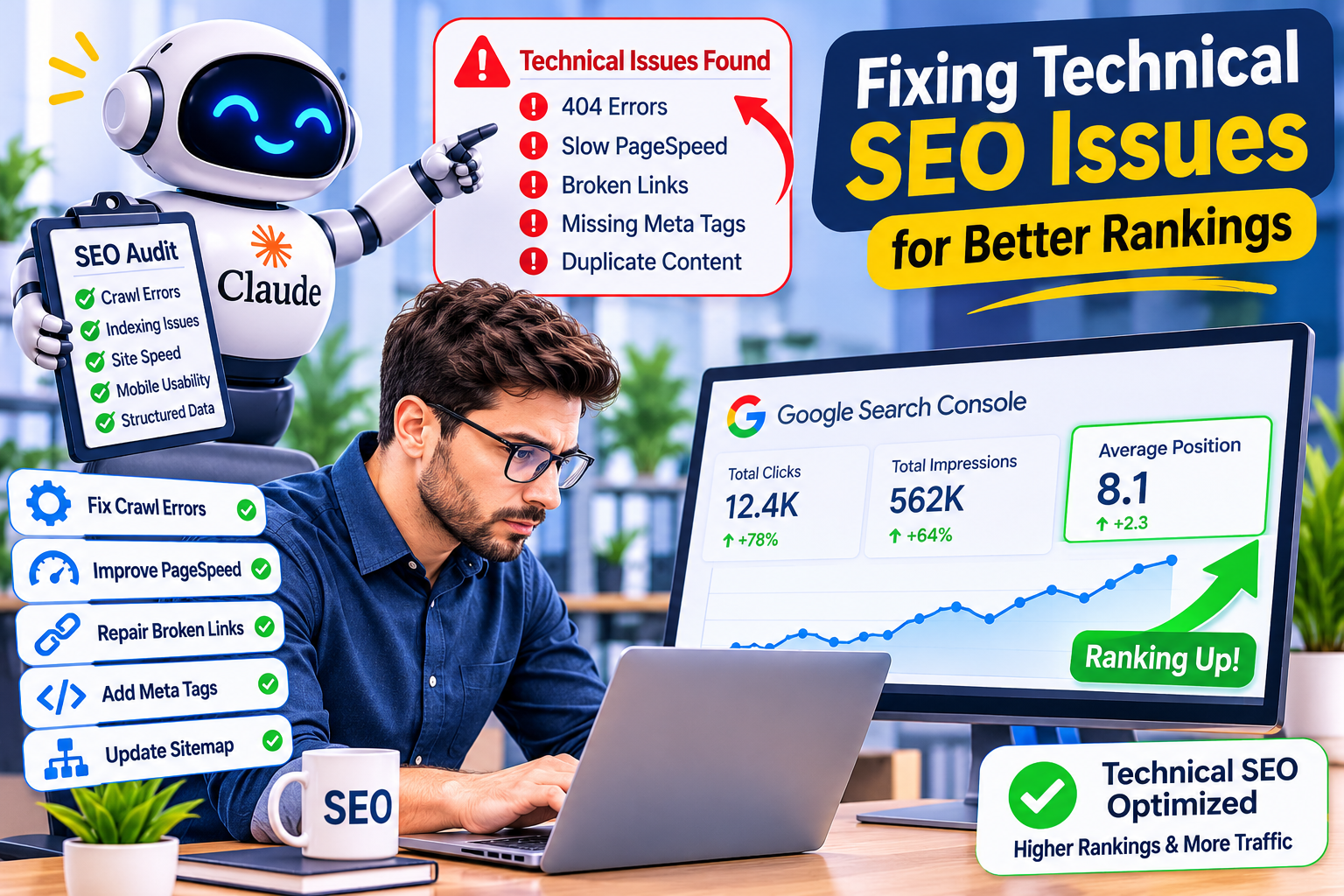
Ordinary Sounding Meta Descriptions and Titles
Writing meta descriptions and titles might feel tedious at one point, and for that Claude is there. Just ask it to write to them and it will do it. However, as it holds no human intelligence, it might miss out on the major keywords that your target audience actually uses, also the humor that only a human writer can add, will not be there.
So, the best trick for such a situation here is to take help of Claude for the initial draft, but rewrite it in your own voice. That will turn it into a clickable title or meta desc.
AI Overdoes with Technical Issues
This is something that can do major damage. AI is well aware of the term “best practices”, but isn’t versed in how to follow it. It might show you canonicals at a wrong URL, warn about crawl budget with a website that has a very few pages or add a no-index tag to a webpage you want to rank on Google.
If you overlook these things, then it can pull a healthy webpage out of the search while it has zero errors. To get rid of such nuisance, review the technical problems on the site before it goes live, especially the redirects, indexing and canonicals. You can obviously instruct Claude the rule, but there’s a low chance it will follow that each time.
Often Misses Patterns and Misinterprets Content
AI thinks you’re an expert, of course you are but AI thinks whatever blunder it creates, you’ll eventually solve it. Therefore, it creates duplicate pages with parameter URLs or applies the same title across many URLs out there. These things will get one look but nothing fruitful will come from it.
It also makes the mistake of handling different scenarios as one. A decision that was supposed to be for one webpage, such as not creating a new one because the home page already has a good rank, applies the same on other site pages where this isn’t an issue at all.
You can explain this to Claude, and it will correct it for you, but you have to point it out first. When an AI or a human assistant resolves their mistakes after you pointed it out, it isn’t that useful.
Link Building Can Become Faulty with Claude
AI sorts the links by authority, relevance and other factors, it can do these drafting faster than anyone, which is obviously a positive thing. However, it can pop up contacts that don’t even exist, drop rows from your spreadsheets and recommend things that don’t fit your brand.
If you allow it to reply to editors, it will make it very generic and no one will give a reply to it. So, it’s best not to risk it and verify your contacts before you send anything to your clients. Also, keep a master copy of all lists. The time you spend on creating context, you can give that time to these verifications.
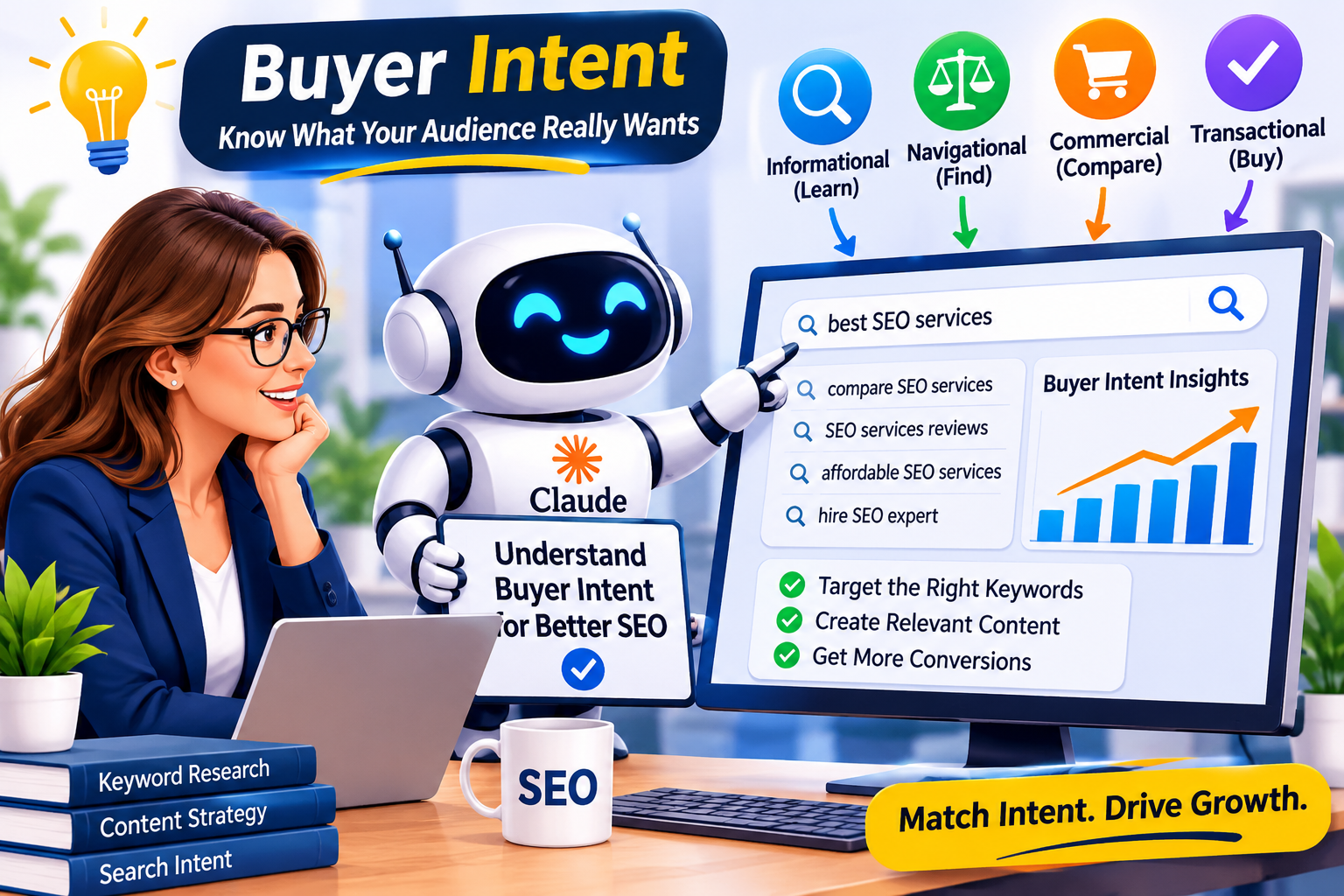
Claude Matches Keywords but Avoids the Intent
Long keywords are a hassle to create but Claude does a pretty good job, and within seconds as well. But does it have the intelligence to understand the intent of customers? No. It can group research questions with buying questions or end up recommending keywords for a page that isn’t proper.
The review process here is easy: take a look at the live search results for each crucial term. If the top result is a guideline and you have a webpage for products, the match isn’t relevant. It might look good but the intent doesn’t match. This one can be read from the results, and this reading part is still human.
Parting Thoughts
AI platforms such as Claude, ChatGPT and others know about SEO, but they have zero idea about your business, its audience and issues. This is where you need your own expertise, and this AI can’t be taken away.
You can use AI for faster sorting, drafts and analysis, and make the final decision with a person who knows your business and has real expertise.
Always remember, the best SEO isn’t the one who avoids AI, the best one is that detects the wrong things.
And if you’re looking for AI SEO services? Then look at none other than One Design Marketing Technologies. We are the top rated SEO company that offers best SEO services that give real results. So what’s the hold up? Contact us today!
How to Segment SEO Data for Multi-Location Brands
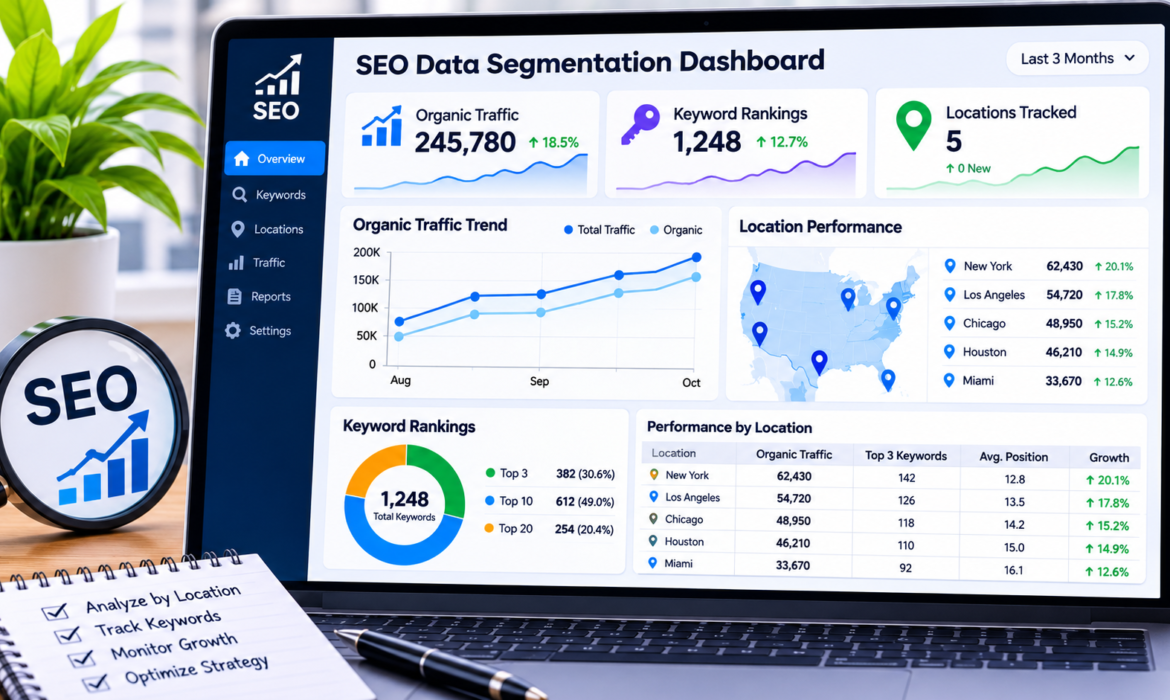
As far as managing SEO for a brand with multiple locations, tracking website performance is not enough. The audiences, search behaviour, competition and ranking opportunities are different in each location. Combining all the information into a single report may obscure important performance gaps.
With SEO data segmentation, companies can see how each location is performing and where they need to make improvements. It breaks down website performance into meaningful groups. This makes it easy to spot local trends, compare results and allocate marketing resources effectively.
For multi-location brands, this method provides a better understanding of how local SEO efforts contribute to overall business growth.
Why SEO Data Segmentation Matters for Multi-Location Brands
A business operating in a number of cities cannot expect to attract the same level of customers in each city. Markets differ greatly in search demand, local competition, consumer tastes and visibility. For example, a restaurant chain could do well in location searches in Delhi, but struggle to be visible in smaller states such as Bihar or Uttar Pradesh. If you only looked at overall organic traffic, this difference could be hidden.
With SEO data segmentation, marketers can spot these variances before they affect business performance. It also enables teams to:
- Organic traffic analysis by location.
- Determine what cities are dropping rankings for the keywords.
- Understand which local pages generate enquiries and conversions.
- Evaluate the impact of location-specific SEO campaigns.
- Find opportunities in markets with limited search visibility.
Instead of relying on broad website metrics, businesses can make decisions based on individual market performance.
1. SEO Data Segmentation by Location
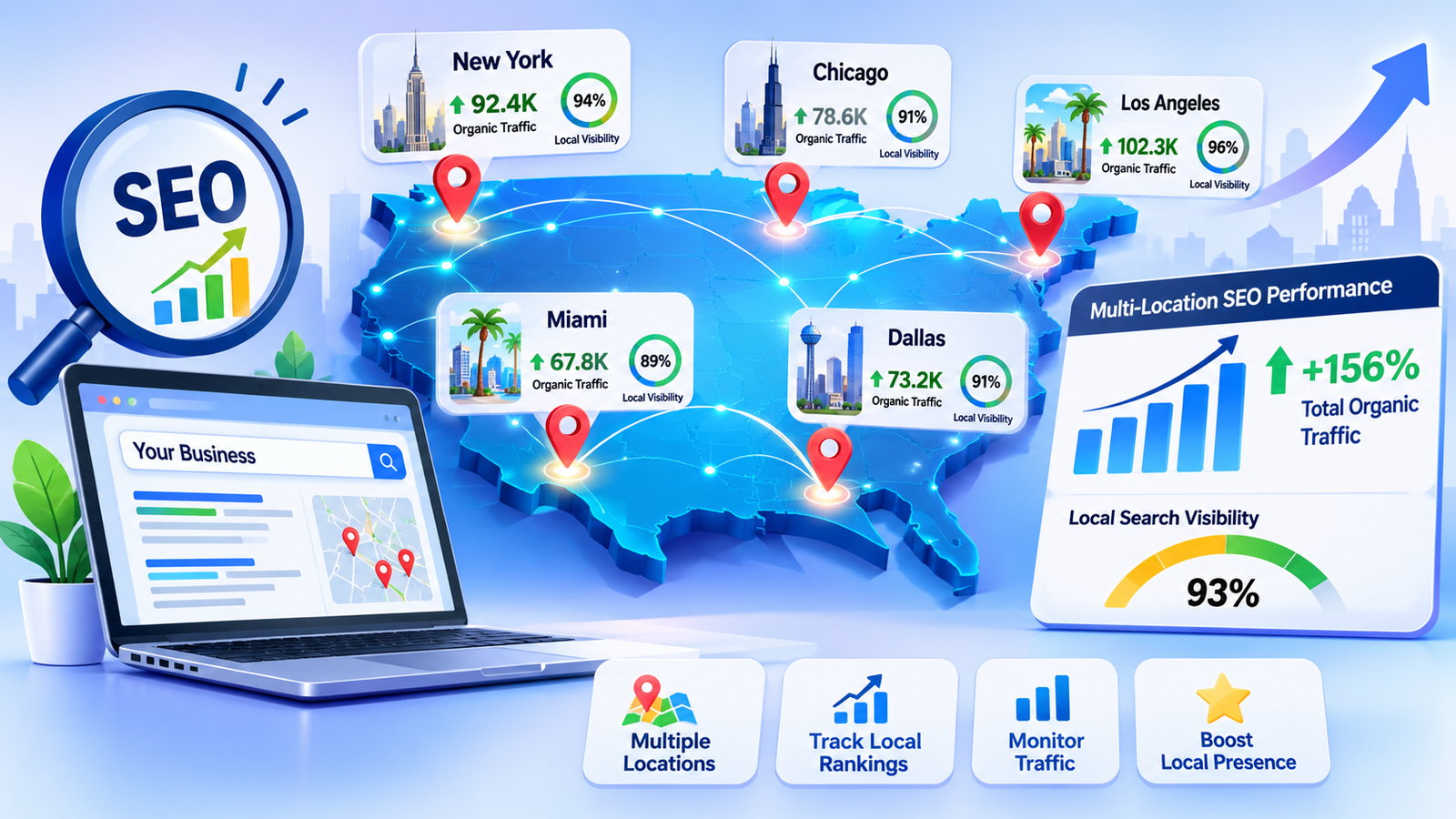
The first step of SEO data segmentation is to organize SEO performance by geography. Each business location should have its own set of performance data, whether that’s through separate landing pages, subdirectories or separate websites. For example, if a company is running its business in Delhi, Jaipur and Chandigarh, it should track each location separately. This helps you to understand which markets are driving organic traffic and which markets need to be focused on. Useful metrics are:
- Organic clicks and impressions.
- Local keyword rankings.
- Location-specific landing page traffic.
- Conversion rates and enquiries.
- Local search visibility.
Google Search Console and Google Analytics 4 can help collect these insights. Location-based filters and landing page reports make comparisons easier.
2. Group Keywords by Search Intent and Location
Keyword performance gets more meaningful when businesses organize search terms by location and user intent. A person looking for an SEO agency in Delhi might be looking for service providers nearby. Meanwhile, someone else might be looking for SEO pricing in Delhi to compare agencies before they decide. Both searches have geographical intent, but are in different stages of the customer journey.
Create Location Specific Keyword Groups
Group keywords into categories like:
- Service keywords: SEO agency Delhi, digital marketing services Mumbai
- Informational keywords: How local SEO works, local SEO strategies
- Transactional keywords: Hire SEO consultant Jaipur
- Navigational keywords: Brand name with a specific city
This enables marketers to understand what locations drive different types of searches. It also identifies gaps in content and opportunities to improve individual landing pages.
3. Separate Branded and Non-Branded Search Performance
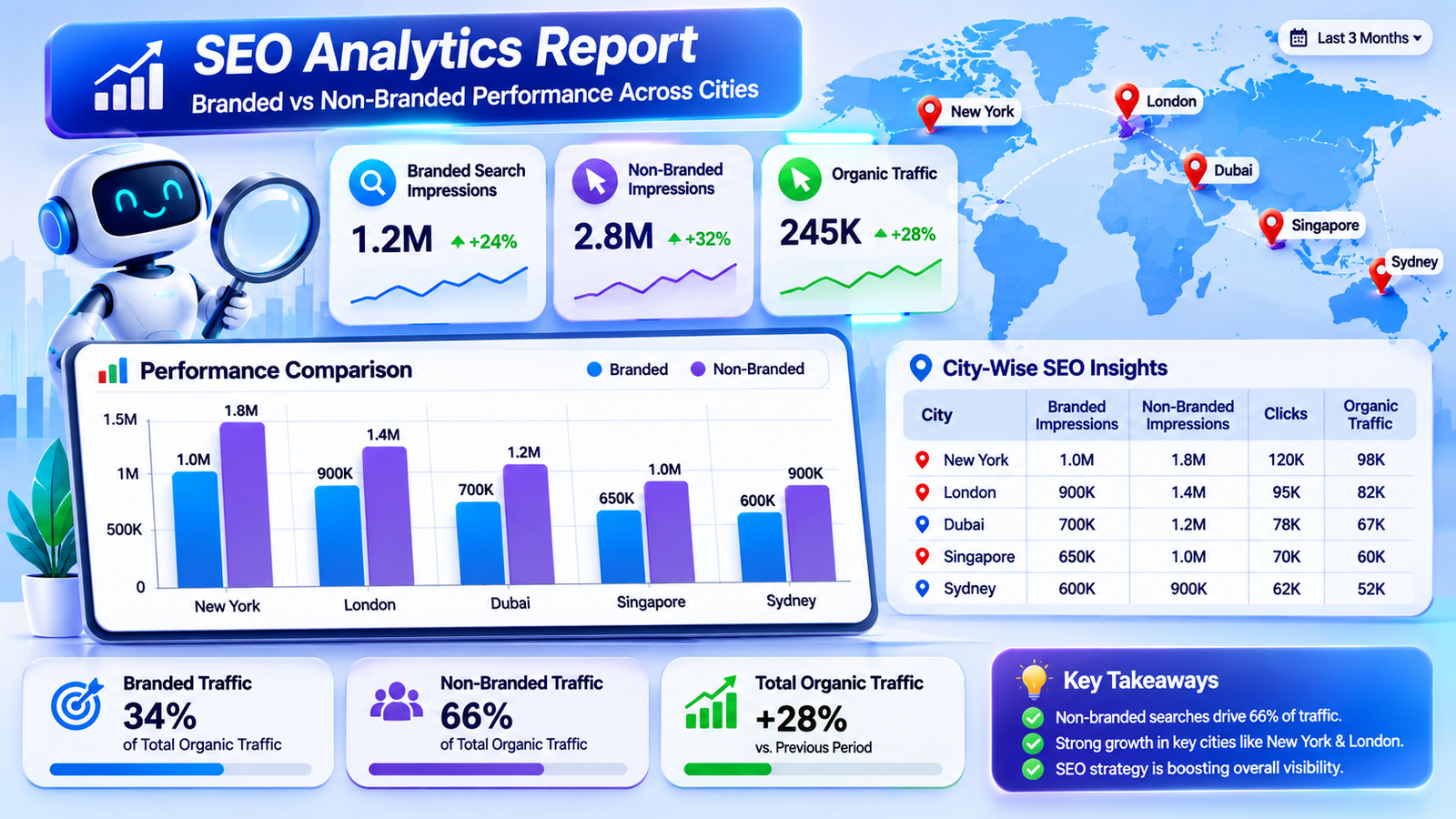
Non-branded searches are usually the first point of contact with the brand for new customers. Branded searches indicate that the user is already familiar with the business These metrics, in conjunction with organic performance, can be challenging to interpret.
For multi-location businesses, branded searches should be tracked separately for each market. This helps to see if brand awareness is increasing in specific cities.
An increase in branded searches, for example, in Pune could mean better local awareness. At the same time, a high number of non-branded impressions with limited clicks may be a sign that title tags and meta descriptions need to be improved.
SEO data segmentation makes it easier to spot and interpret these differences across individual markets.
4. Analyse Local Landing Page Performance
Location pages often serve as the primary entry points for customers searching for nearby services. However, publishing multiple landing pages does not guarantee that every page will perform equally well. Businesses should evaluate each page using metrics that reflect both visibility and engagement.
| Metrics | What it Reveals |
|---|---|
| Organic traffic | Number of visitors reaching the page |
| Bounce or engagement rate | How visitors interact with the content |
| Conversion rate | Percentage of visitors completing desired actions |
| Keyword rankings | Visibility for location-specific searches |
| Average engagement time | How long visitors engage with the page |
These insights help to identify pages that are underperforming and opportunities for improvement. For example, a location page that gets a lot of traffic but not many inquiries may need clearer calls to action, better local information or stronger descriptions of service.
5. Compare Competitor Performance Across Markets
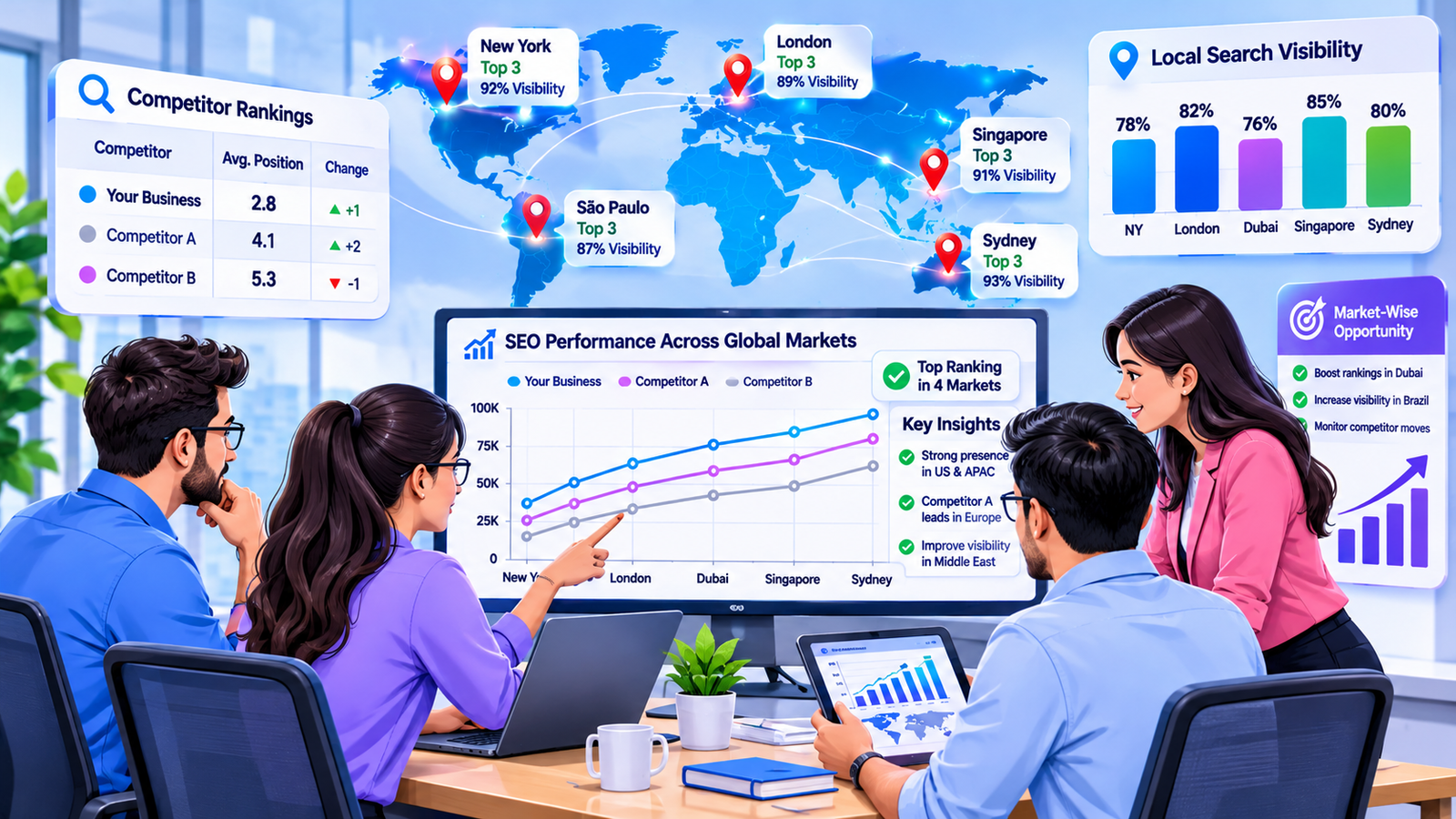
Competition is not uniformly applied across geographical markets. In one city, a business might be competing with established national brands, whereas in another, it might be fighting against smaller local businesses. So, competitor analysis should also be broken down by location.
Determine the websites that are ranking for important local keywords in each market. Examine their content, backlink profiles, local listings and search visibility. This kind of analysis can uncover opportunities that wider competitor research may not. For example, a competitor that dominates search results in Bangalore may not be visible at all in Hyderabad. This might be an opportunity to improve location specific content and local authority with SEO data segmentation.
Common Mistakes to Avoid When Segmenting SEO Data
Even well-structured reports can lead to misleading insights if businesses miss important details. Steer clear of these common mistakes:
- All locations together: Aggregate metrics can mask weak performing markets.
- Ignoring search intent: Similar keywords may be used to meet different customer needs.
- Comparing unequal markets: The performance can be impacted by differences in population and search demand.
- Ignoring conversions: Traffic growth is not business results.
- Inconsistent tracking: Using different measurement methods makes it impossible to compare locations.
Getting the segments right takes ongoing data collection, the right metrics and regular analysis.
Final Thoughts
If you have to manage SEO for many locations, you need a disciplined way to measure performance. With SEO data segmentation, businesses can move away from website-wide reporting to gain insights into what is really going on in each individual market.
Organizing keywords, traffic, landing pages, competitors and technical performance by location will help marketing teams find opportunities more effectively. Regular reporting also permits the adjustment of strategies for local search behaviour. Ultimately, multi-location SEO success is about understanding each market on its own, but still aligning each location with the brand’s larger growth objectives.
When More PPC Budget Doesn’t Guarantee More Leads
Your leads will not perform the same way they always have. You may take it lightly initially until one day and leave you wondering how that happened, I did everything I could!
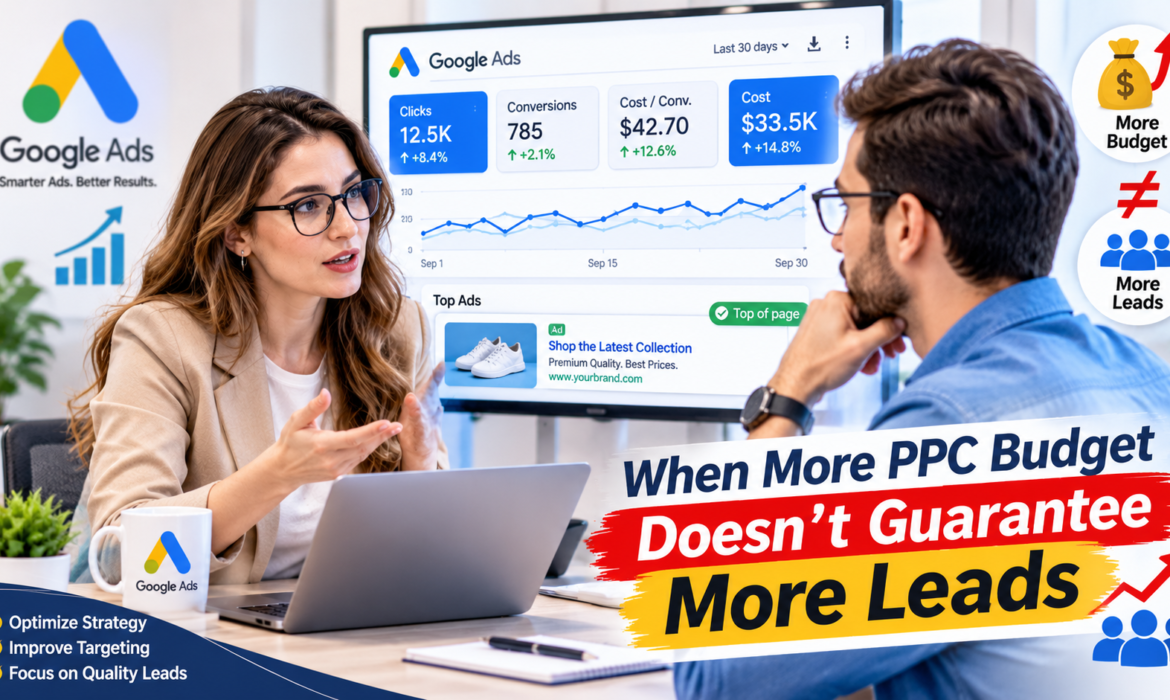
This is really unfortunate that it happened and what do people usually do when it looms over? They spend more on their PPC plan. But the real question is, whether a higher budget can acquire more leads?
Yes, I understand that spending more on PPC services is the logical reaction to this situation, and you’re not wrong to expect more leads because of that. However, this kind of thinking might go against you. Why? Here’s how, if you give your money to the customers who are already looking for you, and give none to ones who want to search for you, you gradually run out of target audiences.
In this article, we’re going to explain why you should think and do about PPC ads differently. Let’s get started.
Search Gets You the Demand but Doesn’t Really Create Anything
When you put a search ad or a PPC ad on Google it reaches the customers who are already looking for you. It’s a promising thing, but you must understand that it’s the final step for those customers, because they have already looked for you online, on Instagram or on a YouTube video maybe, and then they have decided to look you up.
The moment, because of the lower count of leads, you start spending more on PPC services, your investment in other channels basically stops. You might see the rush of traffic and conversion for a while, but that was from the previous impressions, nothing is coming now. So, whatever leads you’re getting now, will eventually stop.
I would like to talk about a personal experience here. A client came to me regarding their low reach issue and wanted to change his PPC service provider. They chose the expensive package, and I wanted to look at their website’s current status. That’s when I got to know how the disaster happened. His leads almost stopped because he stopped paying for the social media, videos and other search gates and only focused on PPC.
So, I suggested they invest simultaneously, and the leads will come. Thankfully they heeded to my advice and their leads came back up with new ones even!
Customers Today Do Thorough Search Before they Visit
Today your buyers don’t buy things just based on keywords. They search for things online, and then look for the reviews on Reddit and other relevant places where they can get real opinions. This means, when they finally appear on your website, they have already done their research on you and have the intent of purchasing.
But there’s always a catch here, which is when bigger brands give PPC ads, it assures customers that “Oh! I know this brand and they sell good products,” as such. But the table turns when it comes to unknown brands, they still have to line up in the crowd. This happens regardless of the same budget and keyword, but always gets a different result, as the customer trust is somewhere else.
Misconceptions about Google Ads
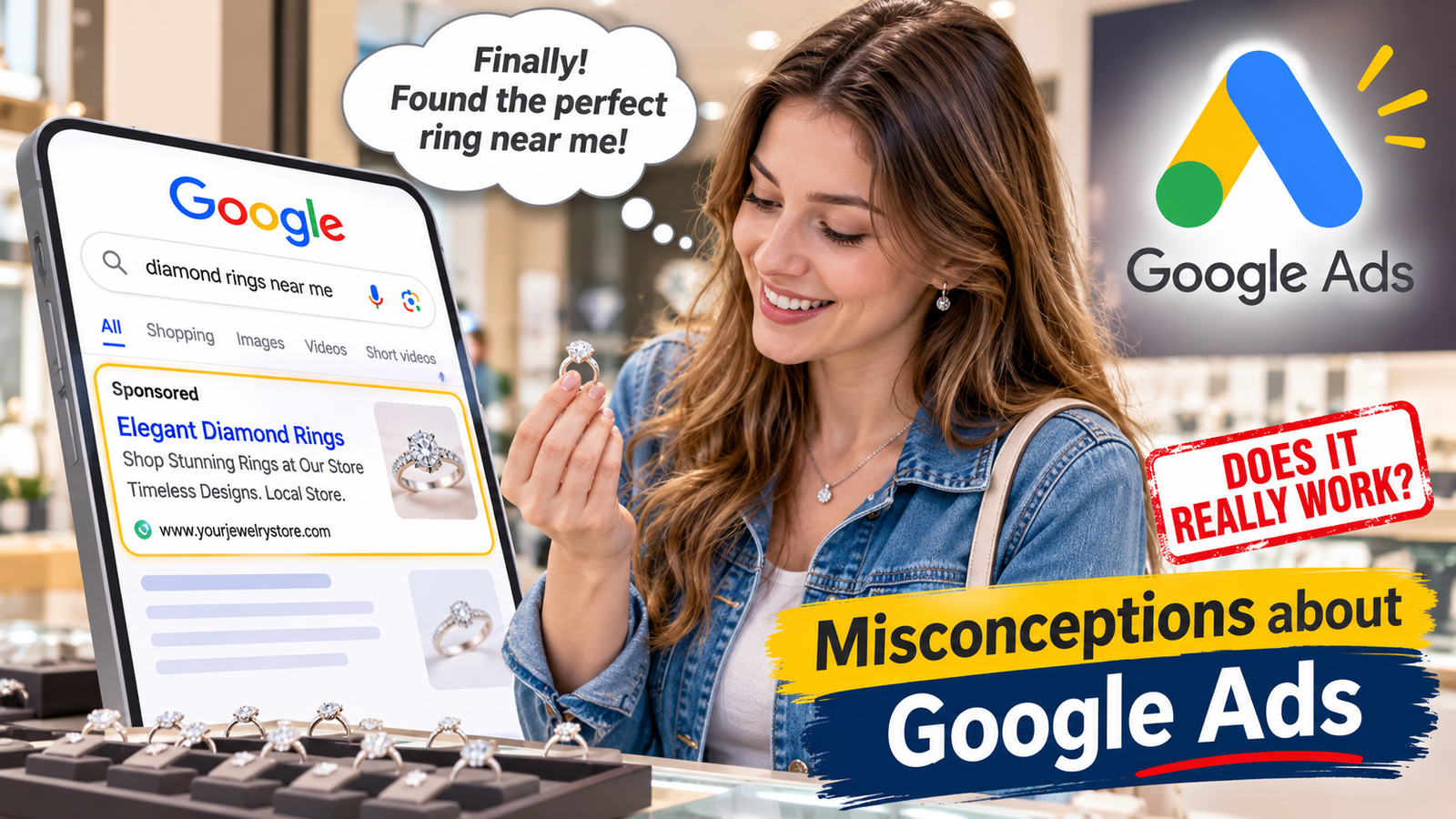
You may have heard that many people these days say that Google Ads don’t work anymore. Things have become harder than before. The conversation always turns like this, “Oh man! You know, AI has taken up everything, those AI summaries; it’s just blocking the simple ways of business!” I mean, I hear you Jeremy, but is it really AI that’s hampering your business or your strategies are lacking?
You keep using those generic keywords, and have zero idea where your investment is going, then the platform isn’t at fault. To recover from this or to completely avoid such a thing, you need to change the plans, see the system as it is now.
Google Ad is still doing its work, but it can’t help with your awareness, reputation and trust.
Small Changes Will Not Solve the Larger Issues
The results aren’t what you expected, it’s lacking somehow. So, your natural response is to change the headlines, rearrange the bids and add new keywords. These come naturally, but these are just simple maintenance and not real plans.
An alternate headline will not bring new customers trust on you. A set of new keywords won’t make you rank higher nor will AI cite your brand to customers.
The thing you can do here is to backtrack a little, and find out where your target buyers are giving their time, what they’re finding during their search and whether your website is visible to them or not.
Brand Campaigns Doesn’t Really Build the Brand
When you conduct marketing PPC campaigns, there’s a huge chance that your customers already know your name and you have a good reputation. But this doesn’t mean you’re bringing new customers, you’re just paying more to draw the attention of your existing customers.
You really build your brand through social media, events, communities and other channels. It may be slower to get the results, and it may not be as satisfying as the PPC Ads results, but it’s the real thing that builds credibility for your brand, and you get trusted customers.
Consistency is the Key to Better Leads
You’re aware of the issues and you get involved heavily into fixing that, but this gives you little reward, and then you conclude that awareness doesn’t work at all! But darling, trust is hard earned, in life and in business.
A buyer will first research you for months, then one day they will consider whether to buy from you or not. And this happens especially for big purchases.
Think about a company who keeps showing up in seminars and community events for years and this repeated presence is what gives them the trust. Your online visibility and revenue depends on the same thing.
For example, one of my client’s fashion jewelry business was not that popular among target audiences, even a good rank didn’t pull that many customers online. But they held on, I helped them with their strategies, and now they’re in a much better position.
Take a Look at the Full Picture before Allocating Your Fund
Before you invest your hard earned money anywhere, know some things about your buyers. List some questions, such as how did they hear about your brand? Which search engine did they use for research? And in which places do they check before they get in touch with you? After this, compare your budget allocations.
A sensible thing to do here is to move a portion of your money to the channel from where the most leads and recognition come. Only after that invest in another place you feel is worthy.
Final Thoughts
PPC services are really impressive, they give you more leads, and when you finally decide to spend more on it, you get the happiness of more customers for a while. Remember that “for a while” thing, because after a year, all the love goes out of the window and you are left with emptiness.
Don’t let such heartbreak get to you! If there are no customers knocking on your wooden door, divert your attention to the channels where they might do it. Before investing more, understand if your customers really know and trust you before they look for the products.
And if you’re thinking of dipping your toes into the lucrative PPC Ads, One Design Marketing Technologies is here to help you. We are the top-rated SEO company that won’t let you drown but keep you afloat even in the heavy competition. Get in touch with us today!
SEO and Visual Content: How to Use Videos and Images in 2027
When it comes to businesses, search engine optimization is still relevant in this era of AI, and so are images and videos. Mentioning them reminds me of the days when you used to add videos and images to your site for Google to rank it.
Those were golden days, like The Golden Girls. Betty White, her works are still highly appreciated. But the world has changed and SEO is not spared either. To match its step with the current world scenario it has evolved into the age of artificial intelligence. But evolution doesn’t mean things got easier, the competition now is fierce so is the race to get cited and mentioned in AI answers.
So, today when you add images and videos to your website thinking AI will recommend it to someone, it will not happen instaneously. It’s almost like Meghan Trainor singing No. This platform will first take a look at that content, understand it, identify which brand it belongs to and then decide if it’s worth suggesting to a buyer.
Whew! That’s a lot of work isn’t it? But sweetheart this is how SEO with AI works today and you gotta roll with it if you want your business to keep afloat. You no longer get to ask if Google will find your world class images, “no no no!” you ask will AI do me the favor of understanding my pictures, understand the brand it’s related to and if it’s genuine.
In this article, we will help you comprehend the scenario, step by step. Let’s begin.
AI Goes for the Entire Image
Previously, image search worked like it’s in a detective movie, because it matched like fingertips! If the picture looks similar, then this must be it! But Sherlock has evolved too, as AI breaks down the images into several parts.
For instance, take a piece of jewelry where the AI checks the metal color, type, and stone shape and color to detect how they relate to each other. Only after that it understands what the person is searching for.
Think of a physical store of jewels, where a shopper moves through the aisles, picks up something that catches their eye, wonders if it’ll suit them, then thinks of getting it. An AI search helps a buyer through a similar experience.
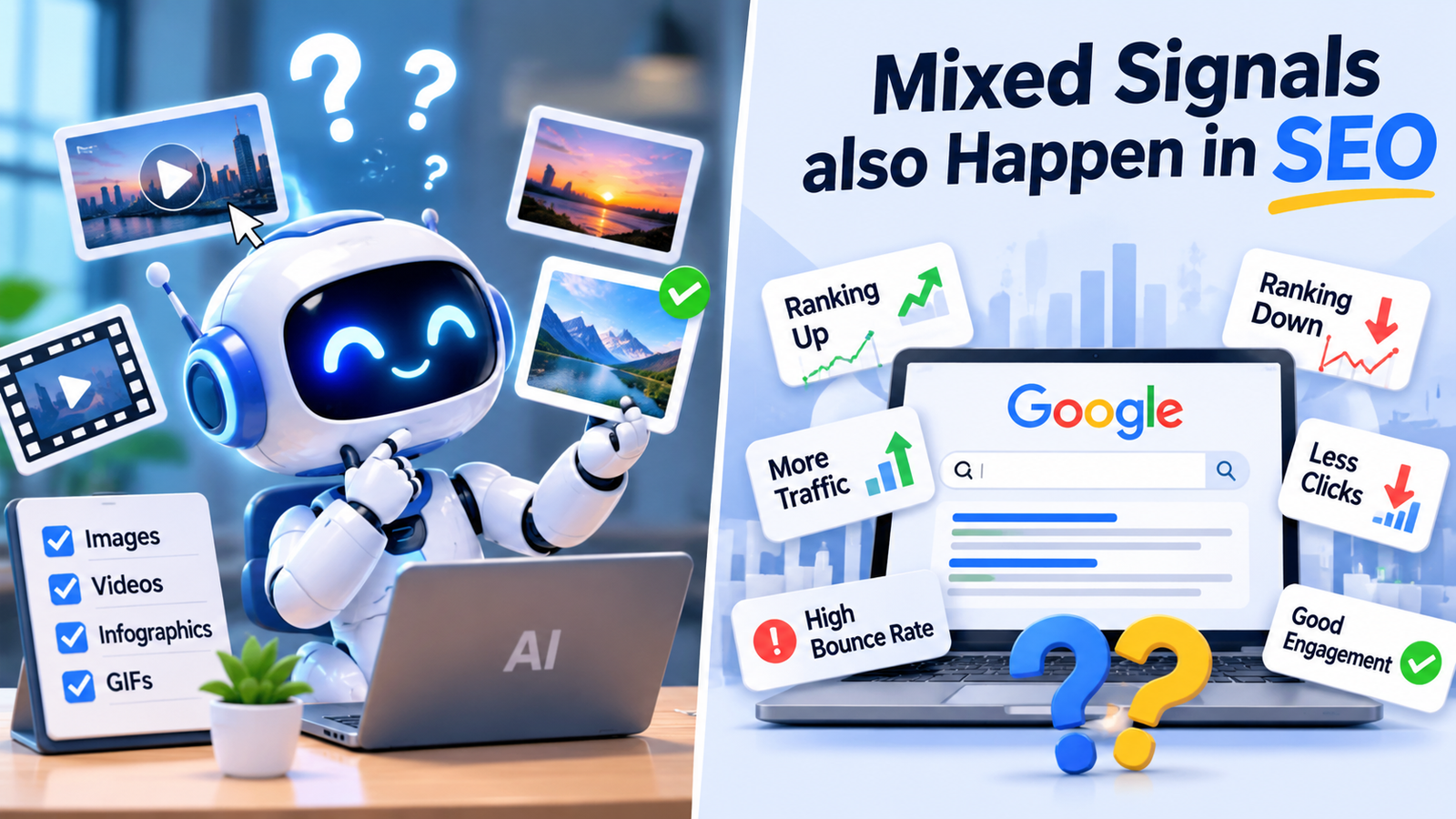
Mixed Signals also Happen in SEO
If you think your dating life is filled with mixed signals, you’re mistaken. Search engine optimization and visual content face this every day, so you’re definitely not alone.
Take a gold ring for example, that displays the name as silver, alt descriptions say something else and the price is different as well. There are three sources with three confusing pieces of information.
If such a thing happens, it’s AI who has to decide which one is correct. The objective here isn’t extra optimization, but agreement. What your brand wants to show, what the buyer sees and the way AI displays it, must all match. If it doesn’t work, then visibility will fail.
Every Image Must Have a Specific Identity
Imagine naming Days of Thunder as Far and Away, because why not, both movies have Tom Cruise and Nicole Kidman! Here you’re technically right, but mostly wrong because they were different movies!
Similarly, you need to mention your pendant piece with a specific name. Just a “diamond pendant” won’t do. It has a diamond, it is a pendant, we all know that, but we don’t know which one it is. It must have its material, price, name and a code that works as its identifier for wherever you’re selling it.
The full information about the piece of jewelry should be in all platforms you’re advertising it. And the product image with details must match the one you have on your official site.
A common trap people fall victim to is when they think more markup is good, but it isn’t. What will actually help you to have a single version that’s true, so you can repeat it everywhere.
Go for the Details on the Images and Videos
This is a simple thing to understand, imagine you need a famous model’s image, like Gigi Hadid, but all you got is a picture of a Barbie doll dressed up in a pants suit. Will it do? NO!
Therefore, you need to use images and videos that are clear, specific and original. If a person is wearing that jewelry, it will help the customers more. If you go for a dumpster of an image that’s overtly polished or not clear or AI generated, AI itself will not accept it.
You can test this easily: If AI and a human looks at your visual content and gives the same opinion, then it’s fine. If it’s vague, then AI will have difficulties picking it.
Image Details Must be Proper
Giving just images with no caption, heading, filename or alt text will make it look like a Jane Doe, on which the police have no idea who the person is. For videos, it must have a transcript with a clear description.
The old rules are still applicable here, the image must be crawlable, have alt text a name with a small detail that will help AI to understand what it’s actually looking at. And when you’re updating a webpage, make sure to update the details on the images and videos, so the words don’t get lost.
Keep Everything Up to Date
If you keep using Henry Cavill’s image for all The Witcher series, it’ll be a blunder, because Liam Hemsworth replaced Henry in The Witcher (season 4). It’s a different story that only a handful of people watched it, but you gotta be correct no matter what.
Similarly, if you keep using the same, worn out images of your products or store front in every platform, when your business has changed a lot, you have a multi-location business and all; AI will not identify those pictures and videos.
The blurry photos, the old ones and the ones you have used even when you started new giveaways or sales, it will not look good and AI will not recommend it to anyone. Make sure each of your videos and images are up to date, and the right images must represent the right thing.
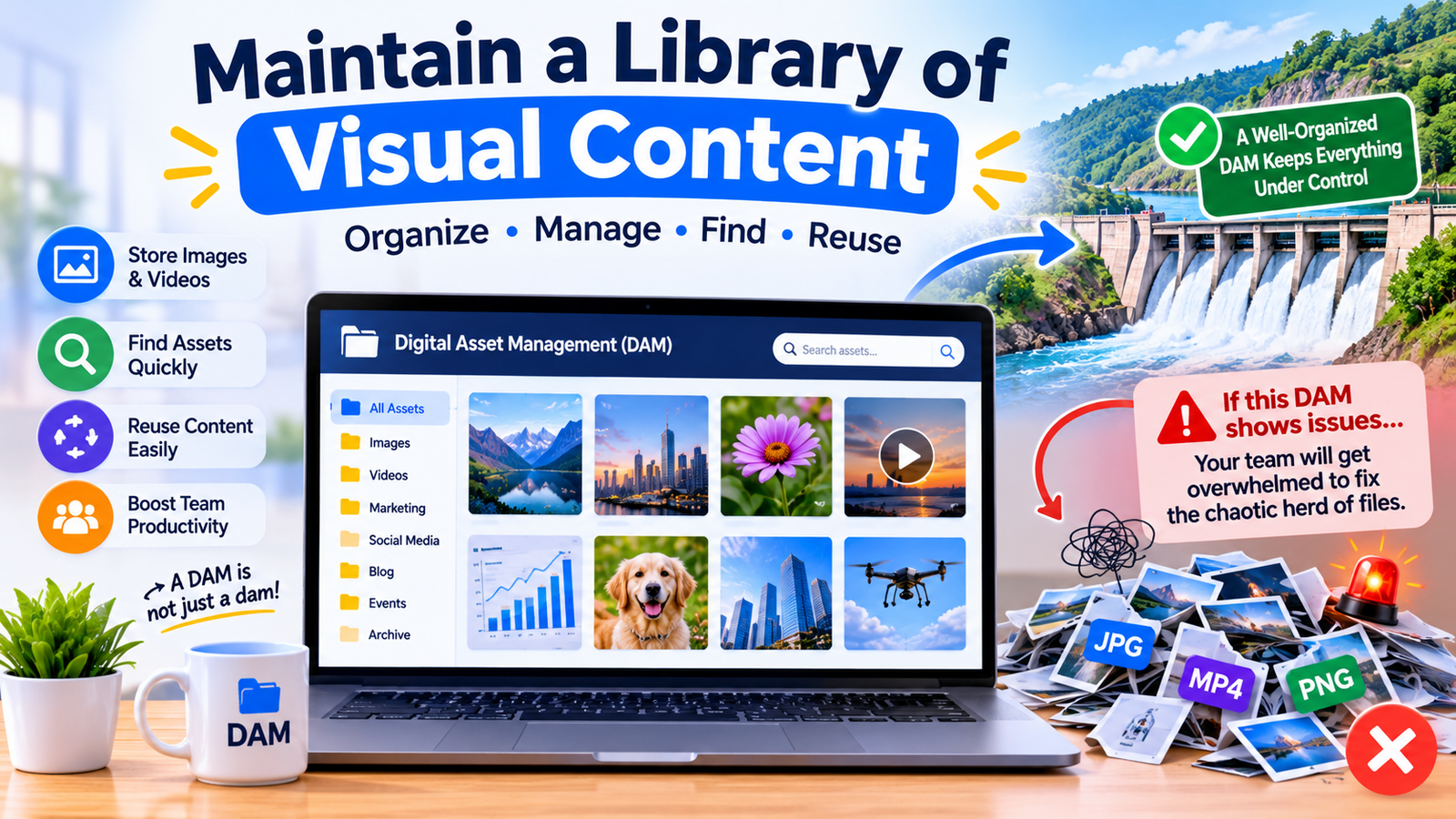
Maintain a Library of Visual Content
Your business already has lots of images and videos, and keeping them organized is the best thing you can do. The place you can store them is called a digital asset management system (DAM). It’s kind of a double entendre, you know! If the dam on a river breaks, it floods the area, and if this DAM shows any software issues, your team will get overwhelmed to fix the chaotic herd of files.
Jokes apart, this library of images and videos are important as it contains the old and new files, the ones that are used, the ones that are approved, the ones that have already expired and so on.
Final Thoughts
AI can create a lot of images, just as you describe it, but when it comes for it to pick them, it only wants to understand it first. When your visual content has detailed information on them, and the images and videos are updated, AI platforms will promptly select them and show it to your customers.
Keep clear thoughts about the images, just where it fits, what it represents and what a person will think when they see it. This simple chain will help your SEO efforts soar.
And if you’re still looking for the best SEO services nearby, One Design Marketing Technologies is there to provide it. We are an SEO company that offers PPC services, content marketing services, AI SEO, LLM SEO and more. Call us today!
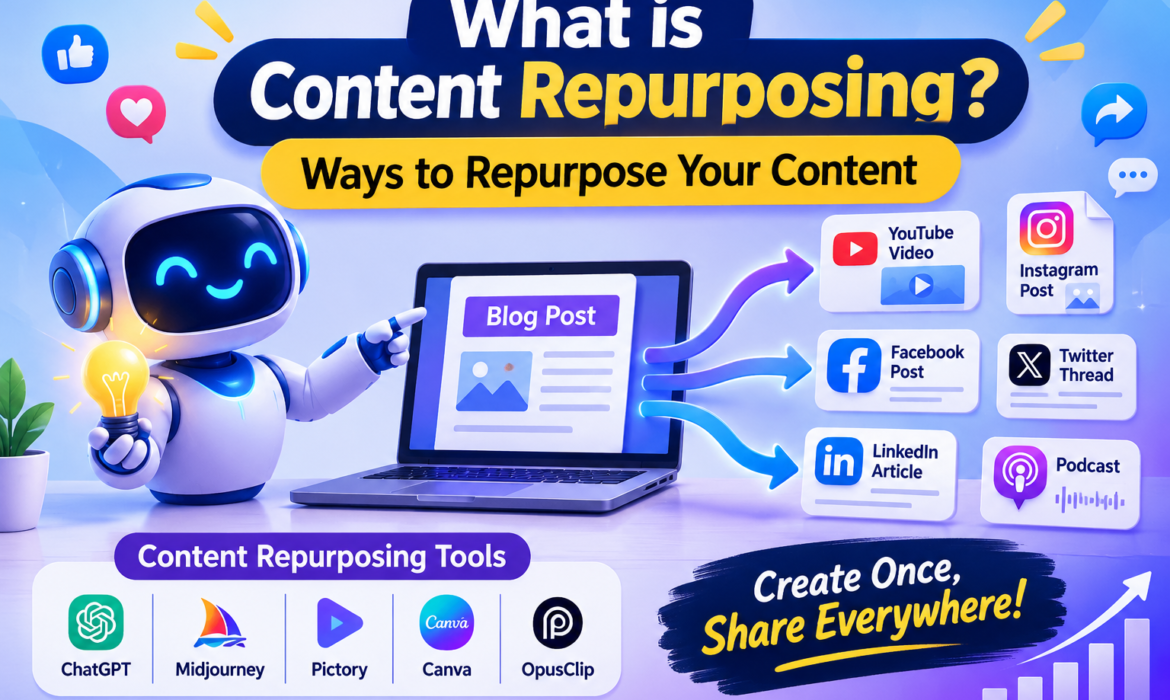
What is Content Repurposing? Ways to Repurpose Your Content
Take a look at the blog section of your website and social media channels, such as Instagram, X, LinkedIn and YouTube. How much content have you published so far and how well is it performing? A detailed report from Google Analytics can give you a clear insight into your website’s content performance and identify content that is worth reusing or repurposing.
That’s what we are going to discuss in this article, content repurposing. It involves modifying the format of the existing published content to create new content. Rather than copying the original, you adapt it to serve different audiences or to promote your business through multiple platforms.
Why Repurpose Content?
Whether you run a small business or manage an enterprise-level brand, content repurposing offers several benefits:
- It saves time and effort of creating every piece of content from scratch.
- It allows brands to continue promoting high-performing content even after it’s published.
- It helps you reach a wider audience through a variety of formats, such as social media posts, videos, interviews, podcasts, blogs and webinars.
- It helps your brand improve its visibility across multiple platforms.
- Repurposed content can attract referral traffic and earn qualified backlinks.
Content Repurposing Checklist
Content repurposing can help you attract a larger audience to your website. However, to get the best results, here’s what you must do:
- Use analytics tools, such as Google Analytics, to identify high-performing content that is worth repurposing.
- Pick evergreen content, such as tutorials and guides, that attract high volumes of traffic over time.
- Analyze which content formats and platforms are most popular among your target audience.
- Before repurposing content for a particular platform, adapt its length, format and presentation to suit that platform.
- Always update the original content before reusing it on other platforms to ensure accuracy.
Effective Ways to Repurpose Your Website Content
Content repurposing is not a big deal unless you learn to do it in an effective way. Below are some popular ways to do so:
Converting Textual Content into Visual Content
If you have plenty of evergreen written content on your website, why not convert it into videos or other forms of visual formats? However, simply revising your blog article into a video script may not be enough to get the audience’s attention. Use this opportunity to add visual elements to your script, such as animation, images and examples to make your script more engaging.
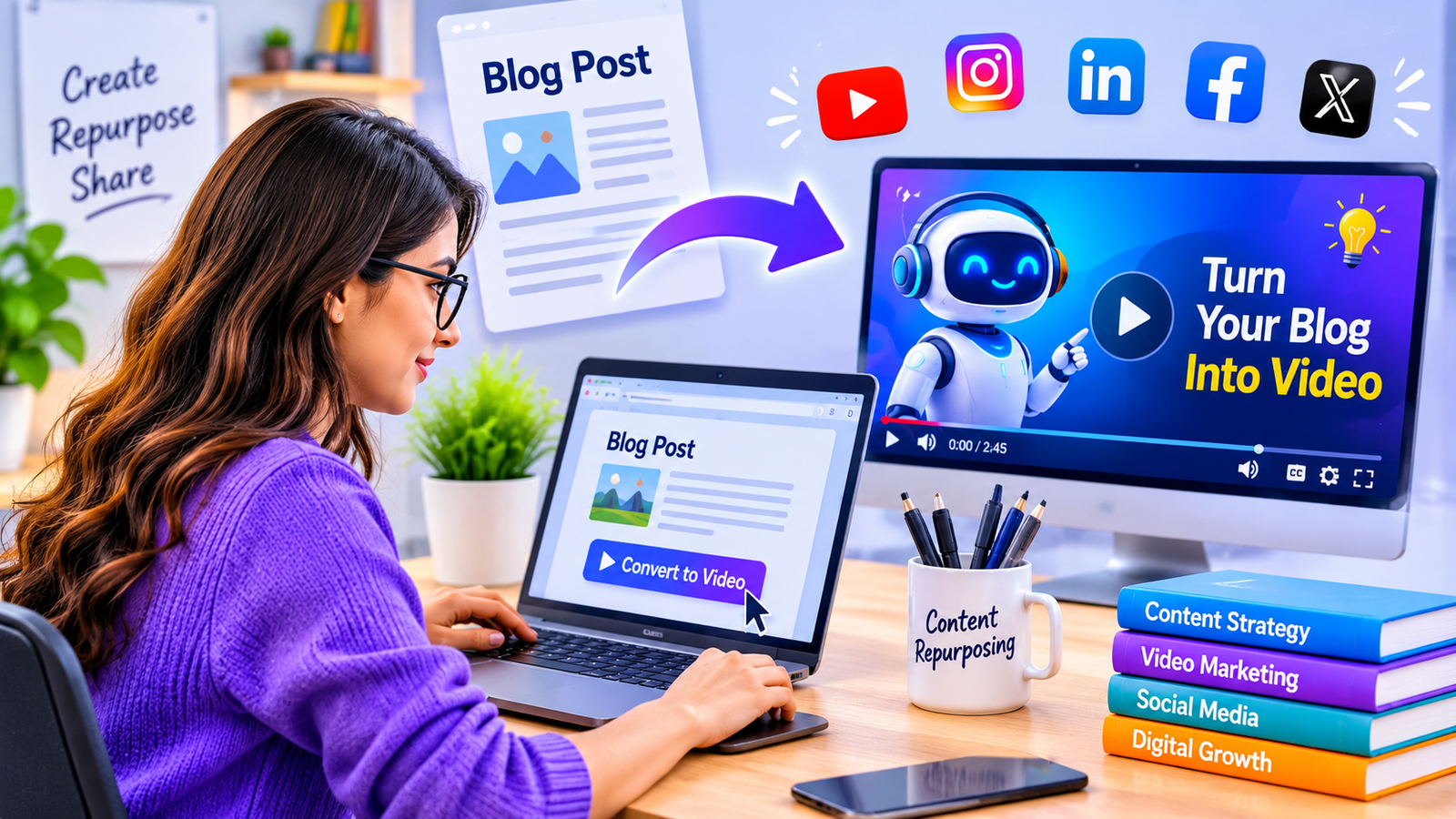
Example: You can convert a blog on AI-powered search engine optimization techniques to an educational video explaining different AI SEO strategies.
Repurposing Videos into Blog Posts
Why not turn your successful videos into blog articles? Start by transcribing the video and noting down the key points. Then, expand on individual points to create a detailed blog post. Include relevant examples, catchy headings and in-depth explanations to make the article more interesting and easy to understand. You can also add the link of your original YouTube video in the post.
Example: Find a high-performing video on your YouTube channel, such as one about Google Analytics trends and convert it into a blog post for your website.
Converting Research into Slide Presentations
Have research papers, reports or whitepapers that you want to share with your audience but worry they might find them difficult to understand? Try extracting the key findings and creating slides with them. Convert statistical data into charts and graphs and use concise text to summarize the major insights.
Example: You can convert a customer engagement survey into a slide presentation by highlighting customer responses and major findings.
Converting Blogs into Infographics
Did you know that presenting complex information through graphics can make it more sharable? Convert your evergreen blog articles into visual illustrations using icons, short text, charts, graphs and other design elements. Infographics work well on social media platforms and can be published as a single post or as part of a carousal.

Example: You can convert a blog post about an SEO process into a detailed infographics showing different steps involved in the process with relevant graphics and minimal text.
Converting Long-Form Content into Short Videos
Learn to identify short segments from long-form content, such as interviews, webinars, YouTube videos and podcasts. These formats cover several topics which you can turn into individual Instagram Reels, YouTube Shorts or bite-sized videos for other social media platforms. Such short content is more likely to attract more views from your audience than the original long content.
Example: You can divide an expert interview on SEO keyword research into multiple short clips and publish them as a series on Instagram or X.
Repurposing Existing Content for Guest Posts
If you do guest posting, you can use your existing high-performing articles to generate ideas. Find articles that bring the highest traffic and identify topics from it for new guest posts. Now, instead of copying the original article as it is, explore specific subtopics that are worth expanding and create fresh content using it. Make the guest post more valuable for your readers by including practical examples, original research, expert opinions, etc.
Example: If you find an existing article on Types of SEO, you could create a separate guest post focusing on a specific topic from the original article, such as Local SEO or International SEO.
Republishing Existing Content
Why repurpose your content when you can get more traction on your website by simply republishing it? Pick your most evergreen content, check it for accuracy and updates, if required and it’s ready for republishing. However, instead of republishing it again on the same platform, choose a different one, such as Medium, LinkedIn or X.
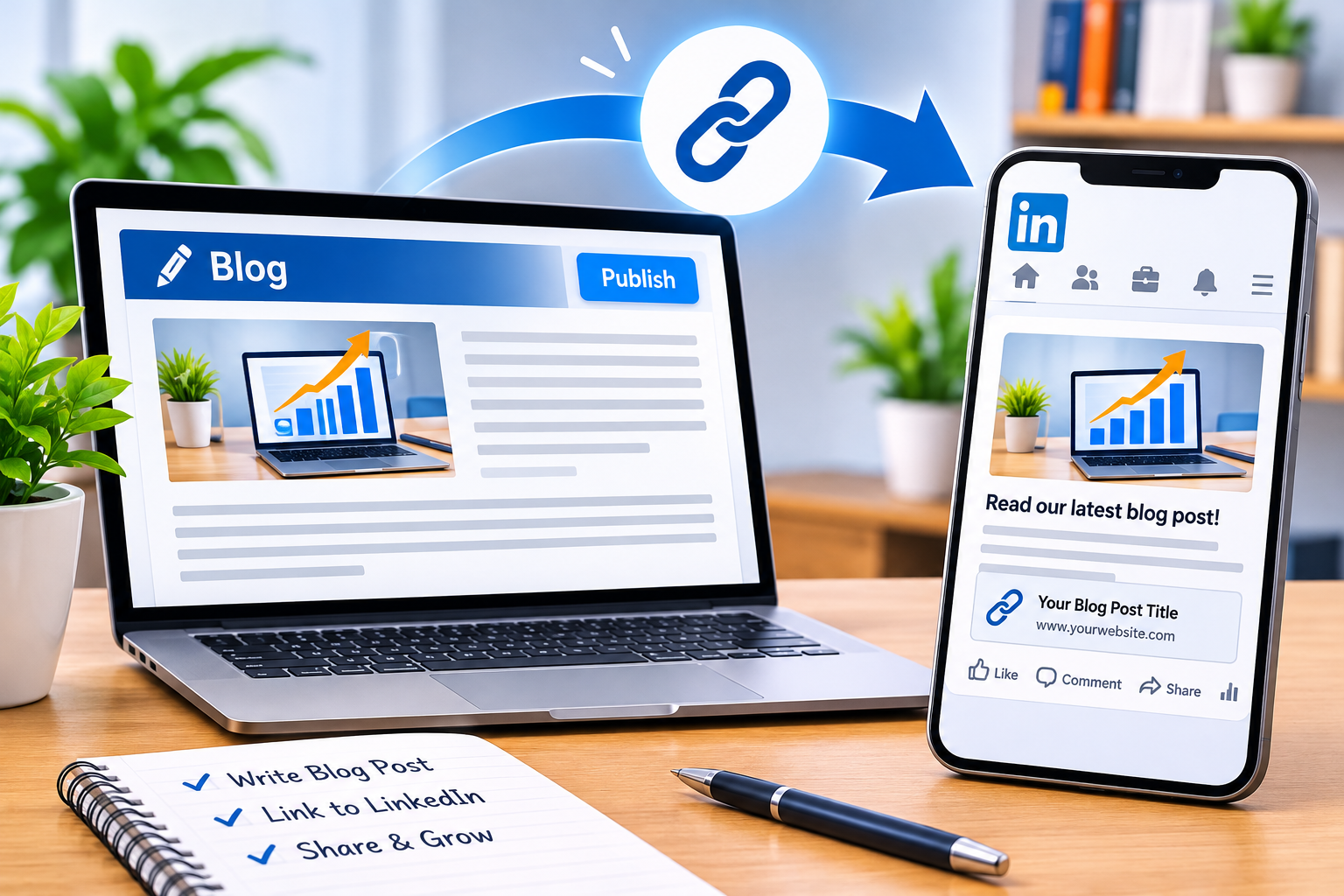
Example: If you have a high-performing blog post on emerging AI technologies on your website, create a fresh LinkedIn post around the same topic, add a fresh introduction and share the link to the original article.
Final Thoughts
Content repurposing is not just about reusing old content on your website. Its main purpose is to gain more visitors on your website or social media channels. The most exciting part is that you can do this in a number of ways, from turning blog posts into videos to converting long videos into small social media clips.
What matters is choosing the right format for each platform and keeping the information relevant and up-to-date. Wondering how to get started with repurposing your content? One Design Marketing Technologies (ODMT) can help you develop a well-planned content repurposing strategy to improve your brand visibility and make your existing content more valuable.

The Trust Crisis: SEO Desperately Needs Accreditation
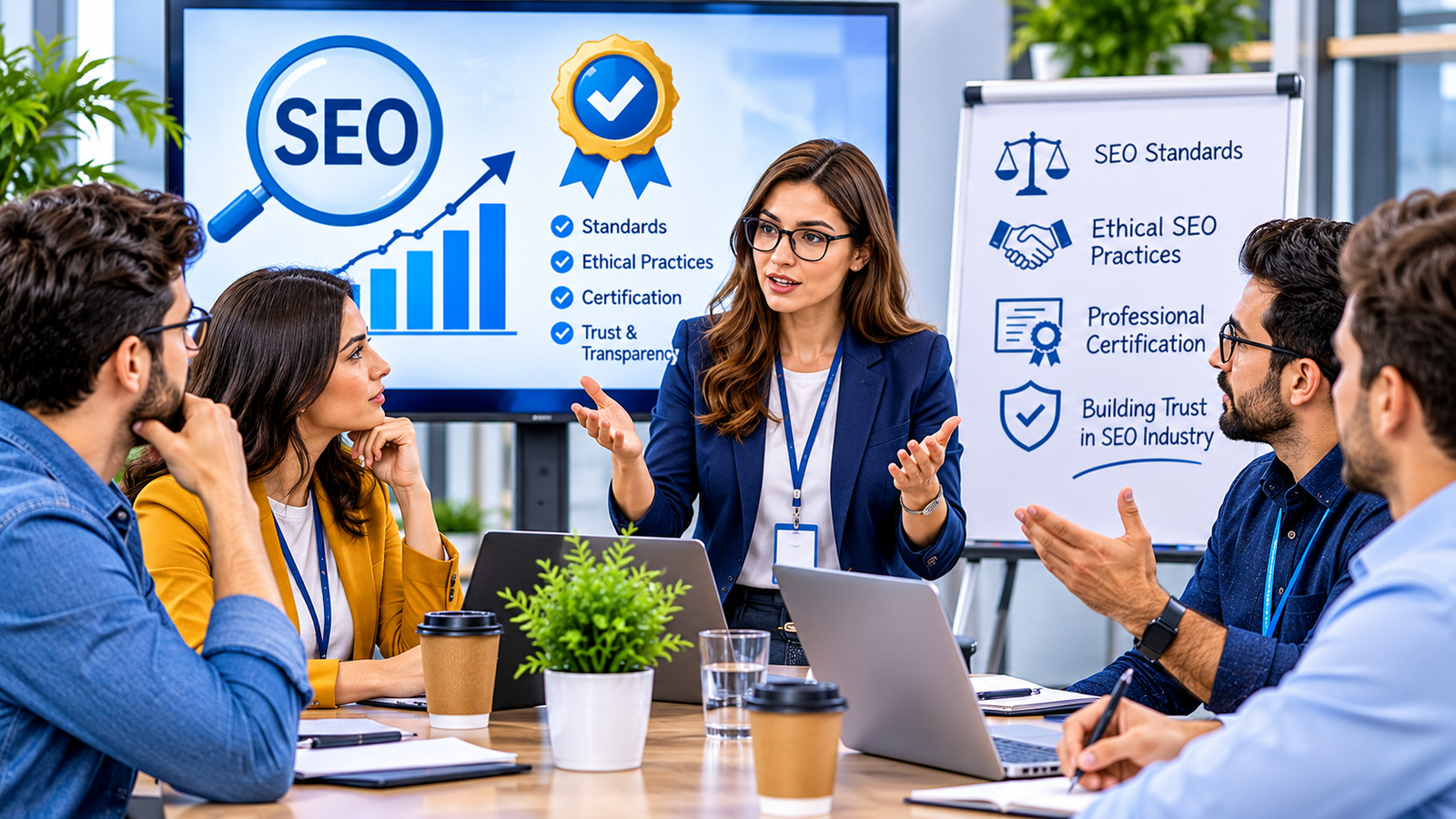
SEO is a crucial part of digital marketing, but it’s becoming harder and harder to trust the people who do it. Businesses spend thousands of dollars on SEO services, that too without knowing if the agency they have chosen has the expertise to get results. Meanwhile, false promises, dubious practices and inflated success stories continue to damage the credibility of the industry.
The problem is not that SEO has no potential. Instead, it’s because there’s no one way to build professional credibility. Unlike many other regulated professions, SEO does not require practitioners to hold a recognized qualification or professional licence. Which brings us to the question: does the industry need SEO accreditation to rebuild trust?
Why the SEO Industry Has a Trust Problem
Anyone can call themselves an SEO expert these days. A good knowledge of keywords, back links and website optimization can be enough to begin providing services. But knowing a few SEO concepts is a long way from understanding how search engines work.
Agencies will often come to businesses promising first page rankings in weeks, guaranteed traffic increases and instant conversion increases. These claims rarely take into account competition, algorithm changes, website quality or search intent.
The absence of standardized professional requirements makes it difficult for clients to distinguish between experienced practitioners and inexperienced service providers. Consequently, businesses often judge agencies through sales presentations rather than measurable expertise. Thus, companies often judge agencies on sales presentations, not on measurable expertise. This increasing credibility gap is why SEO accreditation is worth taking seriously.
What Would SEO Accreditation Actually Mean?
SEO accreditation would provide a recognized framework to measure the knowledge, skills and professional conduct of SEO practitioners. It could offer businesses a reliable way to vet potential agencies and consultants.
However, accreditation should be more than simply taking an online course or passing a rudimentary test. A good system would look at hands-on experience, technical knowledge, ethical practices and an understanding of search engine guidelines.
Skills that an Accreditation Framework Should Cover
A complete evaluation includes:
- Technical SEO: Crawling, Indexing, Site Architecture, Structured Data and Core Web Vitals.
- Content Optimization: Understanding search intent, topical relevance, content quality and the principles of helpful content.
- Link building: What is legitimate link acquisition and what are manipulative practices?
- Analytics and Reporting: Understanding Google Analytics, Google Search Console and metrics for performance correctly.
- Ethical SEO: Abiding by search engine guidelines and not resorting to tricks to optimize.
Such requirements would make SEO accreditation more meaningful than just a certificate earned through theoretical learning.
How Accreditation Could Rebuild Client Confidence
Businesses should not have to be SEO experts to find a good SEO partner. Access to clear measures of professional competence should be available to them. Accreditation can lead to a higher level of accountability in agency-client relationships. Clients could look at verified qualifications and professional standards, not just testimonials and sales pitches.
It might also incentivize agencies to provide consistent service quality. Practitioners would be required to stay current with evolving search technologies through regular assessments, continuing education and professional development requirements.
This is particularly important as AI is changing how people find information. SEO pros today need to understand traditional search engines, AI-generated answers and generative engine optimization and emerging discovery platforms. A credible SEO accreditation program may help define the skills needed to navigate this changing environment.
The Challenges of Introducing SEO Accreditation
Accreditation sounds good, but it’s not going to be easy to implement. SEO is an evolving discipline and search engines update their systems frequently. A qualification based on out-dated ranking practices could soon become obsolete. Therefore, any accreditation would need to be updated regularly and have industry input.
There is also the question of who should be accrediting. If every agency can self-certify then what is the point? An independent industry organisation, professional association or recognised certification body would be better positioned to establish transparent standards.
SEO Accreditation Shouldn’t Become Another Marketing Gimmick
Another concern is that SEO accreditation could become a business opportunity rather than a true quality standard. If certificates are given out for just a fee, they won’t solve the trust issue in the industry.
Assessments must be objective, realistic and based on explicit assessment criteria. But accreditation should be an enhancement to experience, not a replacement for it. A qualified professional still requires practical results, communication skills and the ability to adapt strategies to specific business needs.
The Future of SEO Depends on Accountability
SEO has transformed a lot, but its professional standards haven’t changed at the same speed. Businesses need transparency and realistic expectations, and professionals who understand the responsibility of managing their online visibility. SEO Accreditation will not eliminate bad practices or guarantee successful campaigns.
Instead, it could lay a groundwork for more accountability and help clients make better decisions. As search continues to evolve, credibility will become as important as technical expertise. The industry needs people who can show what they know, talk about what they do and take ownership for what they deliver. Perhaps it’s time SEO stopped relying solely on reputation and started building a stronger system of professional trust.
SEO and Meta Descriptions: Everything You Need to Know in 2027
Search engine optimization remains a work in progress as Google provides new search experiences and people seek answers from AI-powered tools. However, some basics still matter, like how websites appear in search results.
The purpose of SEO meta descriptions is to provide an overview of web pages and give users a reason to visit them. Good descriptions won’t directly impact your Google ranking, but they can make your search listings more informative and attractive.
In 2027, brands need to think more than just adding keywords or fitting text in a character count. They need to be accurate, match search intent, convey value and align with what visitors find post-click.
What are SEO Meta Descriptions?
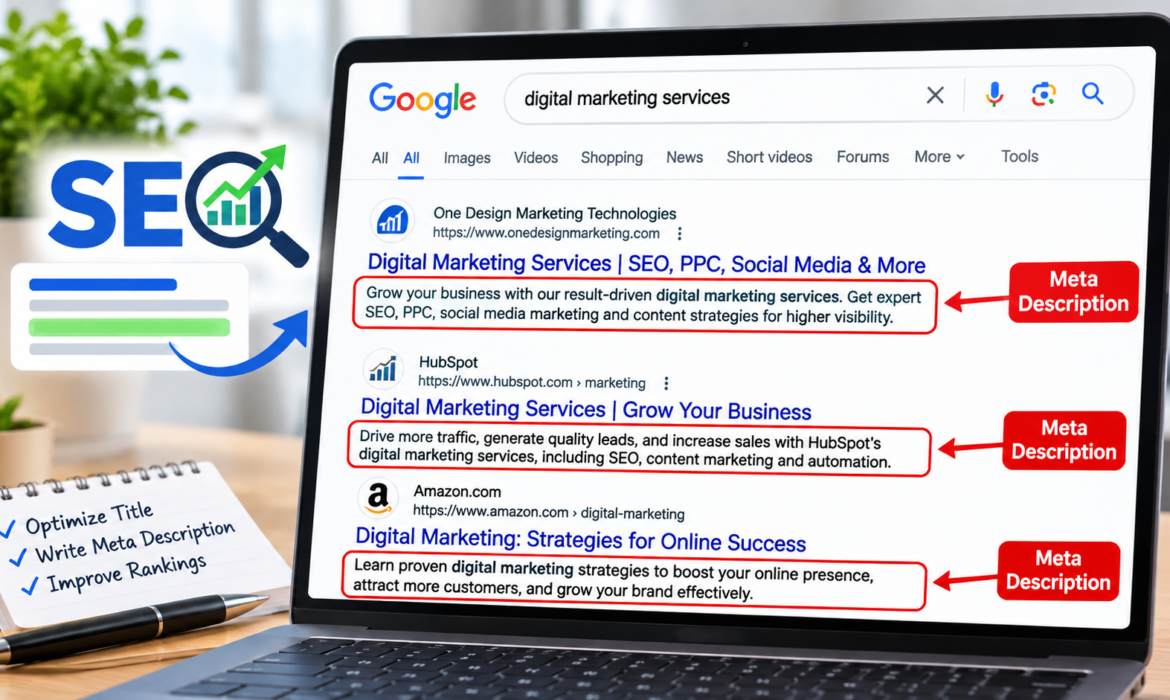
A meta description is an HTML tag that summarizes the content of a web page. It typically appears beneath the page title in search results to help users figure out which result best fits their search query.
For example, a digital marketing agency could provide a short overview of its SEO services, target customers and areas of expertise. In contrast, a blog post might describe the problem it solves and the practical advice it contains.
Here’s what a meta description looks like in HTML:
<meta name=”description” content=”Learn practical SEO strategies to improve website visibility, attract relevant traffic and strengthen your search performance.”>
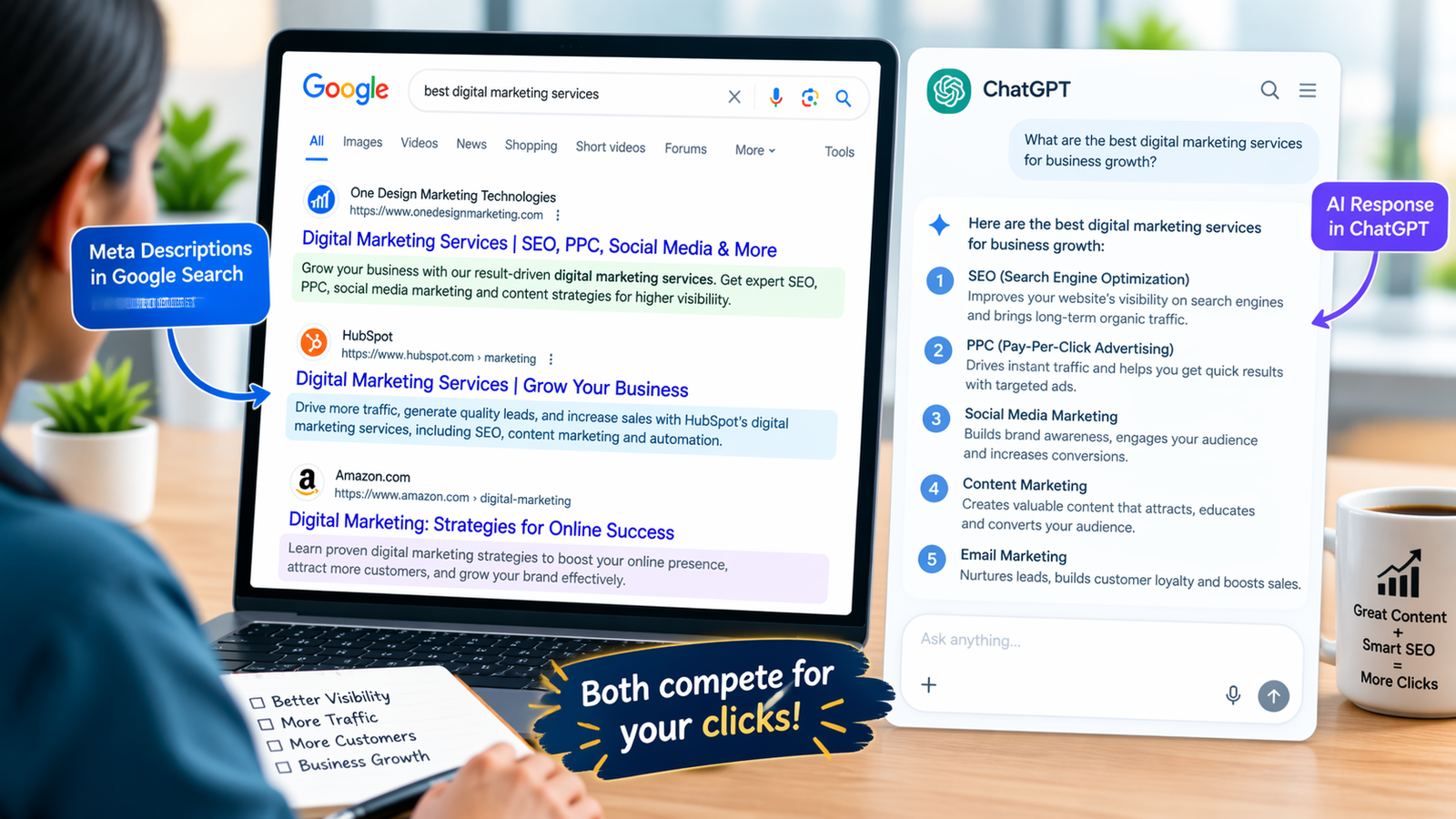
This is the description that may be shown in search results. You are able to create different descriptions by editing the page’s text. Google selects content it considers most relevant to the individual search, so the final wording is not always under your control.
Why do SEO Meta Descriptions Matter in 2027?
Meta descriptions are still the talk of the town because they communicate what a page offers before someone visits it. They are not directly influencing rankings, but their value is in improving the search experience.
1. They Generate Relevant Clicks
A clear description will help users to identify relevant results and set their expectations. When people know what a page has to offer, they can make better choices about which listing deserves their attention. For instance, a description that provides actionable local SEO tips is more valuable than a vague statement on digital marketing. It’s the particular details that grab the readers who care about the subject.
2. They Support a Better User Experience
Good descriptions bridge the gap between expectation and reality. Misleading summaries might get you clicks, but they can frustrate visitors when the page doesn’t deliver. Businesses should see meta descriptions as a brief preview of their content and not an ad full of false promises.
3. They Provide Context for Search Results
Search engines generate snippets based on the page and query. A relevant meta description provides another useful summary for Google to consider when displaying a result. However, no such guarantee exists that the written description will be repeated word for word.
How to Write Effective Meta Descriptions in 2027
Writing good SEO meta descriptions is a balancing act of relevance, clarity and useful detail. The idea is to explain what a page delivers, not to pack keywords into every sentence.
Write Short and Informative Descriptions
There is no character limit for SEO meta descriptions in Google. Instead, snippets are truncated to fit whatever space is available, depending on the device and search result. A practical starting point is 140-160 characters, but this is a guideline, not a hard and fast rule. Put the most important information near the beginning, so that readers can understand the page even when the snippet is cut short.
Include the Primary Keyword Naturally
Using your main keyword helps in making the SEO meta description relevant to the page’s subject. However, repeating the same phrase over and over makes the summary awkward and less useful.
For instance, a page focused on “SEO services for small businesses” could explain how those services enhance local visibility, website performance and lead generation. The keyword should be included in the message naturally, not as the main point. Meta descriptions are not a direct ranking factor to keep in mind. Keyword placement should enhance clarity and relevance, rather than being the main goal.
Match Search Intent
Before writing a meta description, think about what users want to accomplish with their search. While someone looking for information needs a useful summary, a potential customer might want to know what services are offered or what benefits a product offers.
An informational blog could have a focus on the questions it answers. A service page may tell you who it’s for, what it does and why it’s special. A good description for the purpose of the page will attract more visitors to the page.
Make Every Description Unique
Every important page should contain a meta description of the content of that page. When the same summary is used on multiple pages, it is harder for users to tell similar results apart.
For sites with hundreds of product or service pages that can make use of page specific details, templates can be useful in creating unique descriptions. Regularly review those templates, so you don’t create repetitive, incomplete or inaccurate summaries.
Common SEO Meta Description Mistakes to Avoid
Even seasoned marketers can overlook small details when optimizing pages at scale. Steer clear of these common mistakes and your search listings will be better for it.
- Keyword stuffing: Repeating target phrases makes meta descriptions unnatural and difficult to read.
- Writing misleading summaries: Every claim you make must be supported by what’s on the page.
- Re-use of descriptions: Identical summaries do not explain what makes each page unique.
- Skipping important details: Leaving out a product’s key feature or a service’s target audience is a waste of a valuable space.
- Relying entirely on AI: Auto-generated descriptions may be well-written, but they often tend to be vague, repetitive and inaccurate.
AI tools can help with first drafts, particularly for big websites. Yet, human review is necessary to ensure accuracy, relevance and a consistent brand voice.
Final Thoughts
SEO meta descriptions are still a thing in 2027, as search experiences evolve. They tell users what a webpage is about, set the right expectations and give people a reason to click on a relevant result.
The best way to do this is simple: write unique descriptions, match the search intent, use keywords naturally and prioritize useful information over clever, vague language. Review performance regularly and update descriptions when the content or purpose of your page changes.
Ultimately, good meta descriptions won’t guarantee you better rankings or more clicks. However, they can help your website communicate better. Hence, they’re a useful part of an overall SEO strategy.