
How to Build Content Briefs Around Audience Situations

In today’s fast-paced competitive digital marketing environment, brands compete not just for keywords but also for authority. To build this authority, brands need more than keyword-focused content. They need an audience-focused content strategy to attract readers to their websites, thereby increasing the need to build content briefs that address audience situations.
An audience situation refers to the specific context associated with a piece of information. It describes the reader’s problem, its causes, possible solutions and expected outcomes. While designing a content brief, seeking the right keywords is just not enough. What you need to identify is the purpose behind utilizing those keywords.
A situation-based brief helps writers understand this purpose, thereby matching the content with its search intent. This article guides you through the simple steps involved in building content briefs around audience situations.
Identify Your Target Audience First
Keywords can help your content rank higher but cannot help you find the right audience. To attract qualified traffic, you must address your audience’s requirements first. Your content brief should specify the primary audience, major goals, key problem and expected outcome.
Identify the Reasons Behind the Search
Learn why readers would want to search for your content. This can help you understand their point of view and their expectations. For instance, for someone searching for “ways to improve website traffic”, the trigger might be a constant decline in the traffic.
Knowing this can help writers focus not just on solutions but also on the causes and expected outcomes. Some common triggers are a new venture, lack of knowledge, a change in the business environment, a missed opportunity or a business problem.
Create Audience Persona Around Situations
Giving a situation-based persona to every content brief further enhances its usefulness. For instance, instead of mentioning a “digital marketer or manager in his 40s looking for a content strategy”, a better option is to state the real situation.

You can specify something like a “digital marketing manager with a limited launch timeline or one who requires measurable results” for a better understanding of the readers.
Look for Real Audience Problems
Readers aren’t searching for generic information, so don’t give them that. Instead, look into their real-life problems to create the outline for your content brief. Research questions on social media forums, discussion groups and customer reviews.
Look for what people are curious about, what confuses them, what mistakes they often make, what solutions they have tried and tested or where the content gap exists.
Identify the Search Intent
Once you identify the audience situation, understanding the search intent becomes easier. For instance, a user is searching for the “best CRM suitable for small businesses”. Even though it appears to have commercial intent, the user might be searching for a cost-effective automation tool, software for managing a growing sales team or a solution for improving customer engagement.
Pick the Reader’s Pain Points
Your content should solve an existing reader pain point; otherwise it’s of no use. Cover the most common pain points and explain how you address them.
Some of the most common pain points for readers are vague information, poor previous results, high costs, too many options and limited time. The only way to address pain points is to provide solutions to them and that’s exactly what your content should do.
Start with the Basics
Always treat your readers as beginners. No matter what specific subject area you are focusing on, always begin with basic knowledge of the broader subject.
However, your brief should still specify the expected knowledge level of your content. This ensures that the content is neither too basic nor too complicated for the audience it is meant for.
Create Content Based on Audience Situations
Ask yourself what audience situation your content brief is going to handle. This will help you create a content angle or context for your brief. For instance, instead of using the title “User’s Guide to SEO”, a title like “A Practical Guide to SEO for Businesses to Improve Qualified Organic Traffic” sounds more useful. Some other angles could be like:
- SEO for Beginners Starting from Scratch
- SEO for Small Businesses
- SEO for AI-powered Search
- SEO for Generating Qualified Leads
Adding such context to your content makes it more meaningful and easily discoverable for readers.
Create Brief Around Key Questions
Build your content brief around the core questions that align with the audience’s situation. Some of these questions could include:
- What’s the problem area?
- Why does the problem persist?
- Why does it need immediate attention?
- What possible solutions are available?
- Which option fits the audience’s situation best?
- How can you implement that solution?
- What resources are needed to achieve the desired result?
- What are the possible challenges?
- What are the common mistakes to avoid?
Incorporate Content Requirements
Provide clear writing instructions for the writers, specifying the primary situation, search intent, target audience and the content angle. Next, include the list of primary and secondary keywords along with the list of key topics and subtopics to cover.
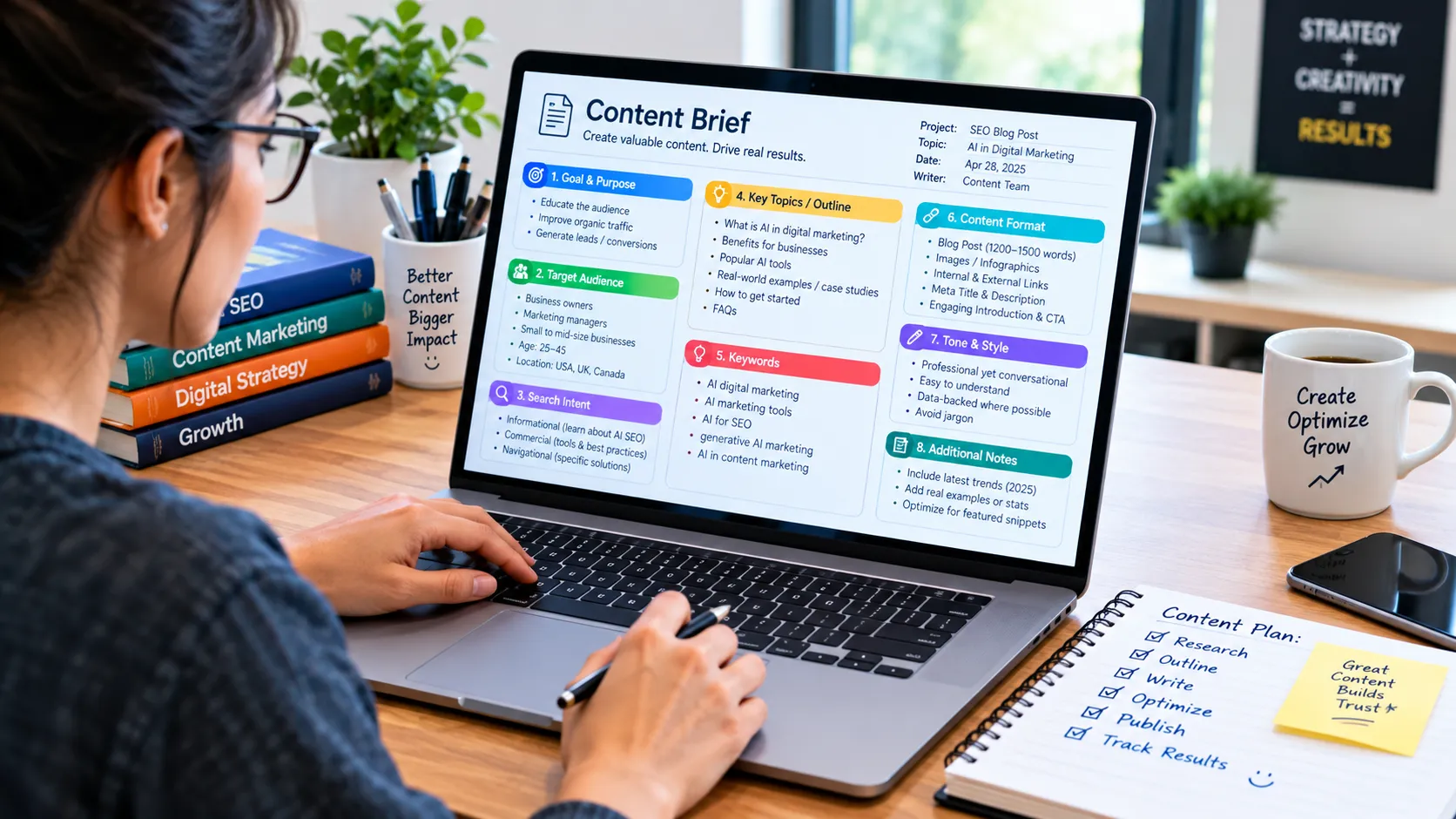
Your content brief should also provide the writers with the key questions to be included in the FAQs and the pain points to be addressed. It is also advisable to specify the recommended structure and examples to be included in the brief.
Include Real Life Examples & Clarify Concerns
What’s a better way to understand a concept than through examples? Incorporating enough examples can simplify complex information. More importantly, use examples that align with the audience’s situation, creating more value for the reader.
Moreover, your content brief should address the reader’s doubts and concerns about the subject matter. For instance, you can discuss in your content how long an SEO strategy may take to show results. You can also specify the cost of implementing an SEO strategy and the expertise required.
Create a Flexible Brief for Writers
Don’t offer a rigid template; instead, provide clear directions on how to draft the content. This will give writers room for creativity to explain the concepts in their own writing tone.
What you can provide is the information that your writer needs to understand the core situation and the solutions to it. The content brief should further specify what kind of data, examples and case studies writers can include in the content.
Update Briefs with Changing Audience Situation
What if the audience situation changes? Several market factors, such as changing regulations, increased competition, new technologies or changing customer buying behaviour, may require you to update your brief on a regular basis.
Identify the shift in the audience’s search intent. How are your competitors addressing the topic? This way you can ensure that your content brief aligns with the audience’s situation.
Parting Thoughts
A content brief doesn’t work on a fixed pattern but changes based on the audience situation. The goal is not just to target keywords but also to understand the pain points of the audience and provide solutions to them.
A well-defined brief should give writers a clear direction on what points to cover and what to avoid. This way, readers get focused content that’s not just relevant but also solves real-world problems.
Are you also looking for an SEO company providing content creation and management services? If yes, then One Design Marketing Technologies offers you a complete suite of AI SEO services along with a free consultation. We offer our clients cost-effective SEO solutions tailored to their business needs and budget constraints. Book your appointment today!