How Google is Viewing Your AI Content?
Imagine a simple scenario. You created most of your website content using AI-powered tools such as Claude, ChatGPT and Gemini without realizing how Google might process it.
On top of that, Anthropic’s Claude introduced invisible AI watermarks from August 2026 to classify Claude-generated text, adding to the gravity of the situation.
However, this AI content declaration does not make it less suitable for Google to rank.
According to Google’s guidelines on using AI-generated content, published in February 2023, high-quality, original content can perform well regardless of how it is produced.
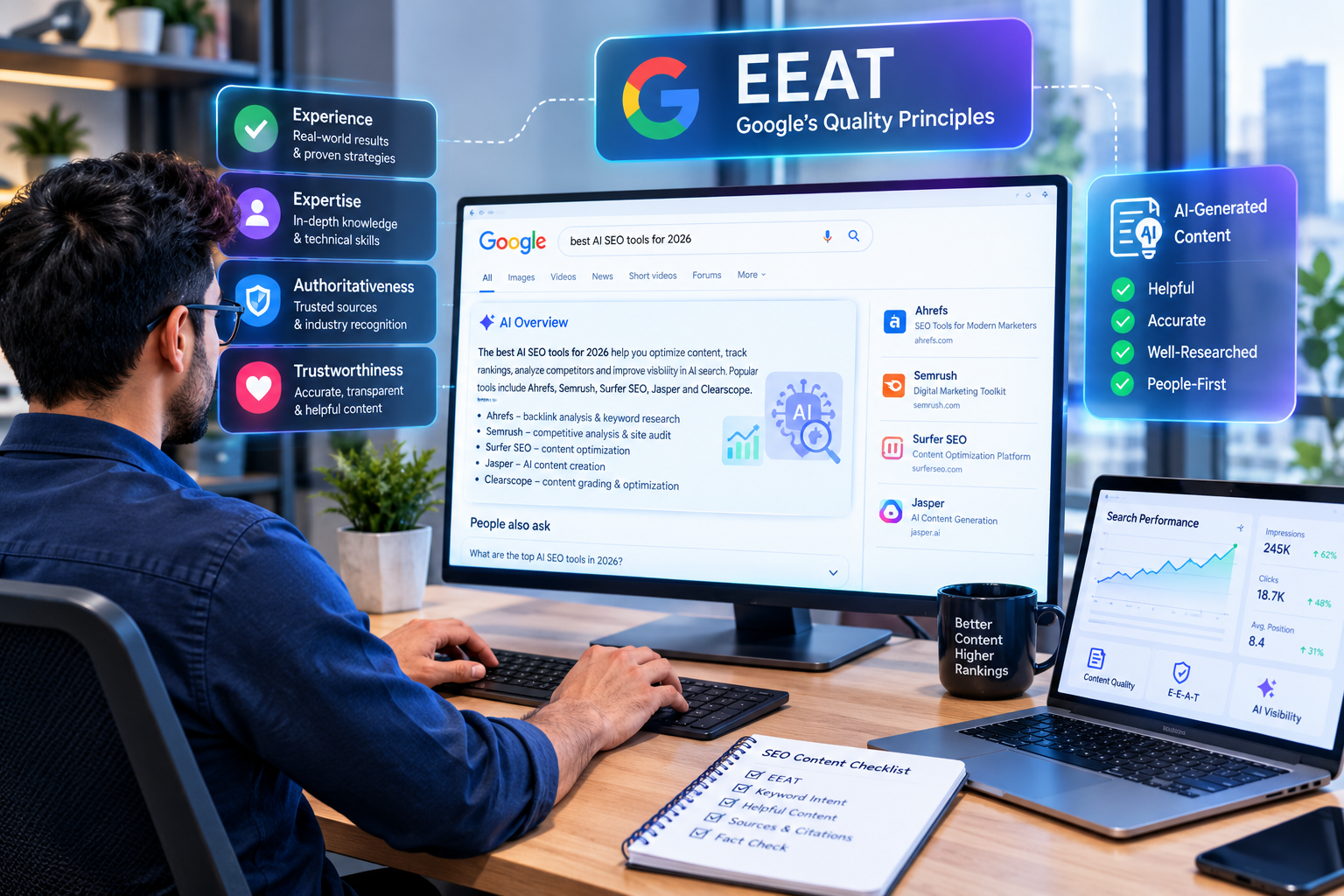
It simply means that as long as your AI content provides value and meets the EEAT (Expertise, Experience, Authoritativeness, Trustworthiness) guidelines, it may qualify to be ranked.
However, your content writing expert must understand the difference between utilizing and abusing AI content. Using AI to generate bulk content to influence search rankings is against Google’s spam policies.
Google’s Criteria for Ranking Content
What Google looks for in your AI content is not entirely different from what the readers expect. A GEO company such as One Design Marketing Technologies (ODMT) can help you understand the difference between AI-generated content that adds value and content that fails to meet Google’s quality standards.
How much effort was involved?
Have you ever wondered why your page struggles to rank at all or the ranking decays over time? That’s because good readability and better understandability does matter but it does not add real value to your content.
But then what does? Real efforts and value addition does. Now ask yourself, what efforts did you make to add value to your website if every bit of it consists of AI content? We can’t say much about the nation but that’s exactly what Google wants to know.
But the real problem is to define what counts as real effort. Well, it can mean adding something useful and interactive to your website that no AI model can’t mass-produce.

Think of a BMI calculator on your health-related website or a tax calculator on a blog related to taxation or accounting. Well, you don’t have to code the logic yourself; AI can help you with that.
Your job is to integrate useful functionality to your website along with your AI content to stand out from your competitors.
Is your content Universal or Unique?
AI content sounds monotonous because most of the time it sounds generic. Do you agree? Take the example of two articles. One is titled- “7 Ways to Take Care of Your Gut Health” and the other is “What Patients With Serious Gut Issues Did To Improve Their Gut Health.”
While the first one sounds generic, the second one seems more specific and hence, authentic. It discusses real scenarios and first-hand experiences rather than offering general advice.
Articles like these can add authenticity to your website content, helping to strengthen the domain authority of your website. Having said that, generic blog articles can still occupy significant space on your website’s blog content.
Does your content sound real?
What differentiates the real from the fake? Well, everything real should be supported by evidence that proves its validity. That’s exactly what your AI content may be missing: verifiable evidence that cannot be fabricated, automated or copied but must be supported by reliable sources.
Google is not chasing dictionary definitions but first-hand experiences, originality and reliability in your content. Wondering how to make your AI content sound real? Add verifiable information to it, such as relevant case studies based on real-world scenarios.
Gather proprietary data from your own fieldwork or actual customer feedback. Incorporate this first-hand information into your AI content with the author’s name, photograph and credentials to make your content sound credible.
Are you using too much text?
Stop adding just magical words to your AI content. Instead, add some multimedia elements, such as short videos, infographics and tables.

This simple step helps your page stand out from most websites still chasing word counts. Moreover, combining meaningful diagrams, graphs and charts makes your content easier to understand. This way, it manages to reach more search engines and more readers.
But what matters the most at the end of the day? Ensuring that the data your infographics point at is yours and only yours. Here’s how to execute this step. Share your original raw data with your SEO company and their team can help you turn that data into engaging visual content.
What AI Content Does Google Flag?
By the end of this article, we know what Google looks for in your content. But what kind of content Google blacklists is still the biggest question left unanswered.
Well, the answer is very simple. Those trying to outplay Google by generating hundreds of AI articles only to manipulate search rankings need to stop now.
It’s not the AI watermark you need to be wary of. It’s the mass-produced AI content that offers little to no value to your website.
An AI watermark may flag your content as an AI-generated text, but it does not entirely influence your Google ranking.
What still matters is if your AI content offers any real value. Bring something unique to the table, anything useful that the rest of the pages on the SERP are missing. Who knows that might change the game for you?
Should I Choose AI Over SEO?
No, ODMT recommends that its clients avoid relying on AI blindly when implementing their SEO strategies. Incorporating AI into both SEO services and PPC services is indeed a tempting opportunity. However, a real AI SEO company knows where to draw the line.
Stick to using AI for idea generation, summarization and automation. But, rely on human expertise for analysis, strategizing and decision making.
We, at ODMT, follow the same approach. Our comprehensive AI SEO services are built around a customized AI SEO strategy developed exclusively for each individual client. Besides, with our SEO professionals backing your SEO journey with their 15+years of expertise, we help improve your chances of success.
Want to find out the SEO health of your website? ODMT is an SEO company offering a free website audit. Claim yours today by getting in touch with us.
FAQs
Is it against Google Search’s guidelines to use AI content?
Google doesn’t prevent you from using AI content as long as you don’t misuse it to manipulate search rankings or violate Google’s spam policies.
Does Google Search ban AI content?
No, Google Search has never banned AI-generated content altogether. Content writers can use AI to generate innovative ideas and create meaningful content.
Can AI content rank higher on Google Search?
If your AI content offers valuable content and meets the EEAT (Expertise, Experience, Authoritativeness, Trustworthiness) criteria, it might rank well in Search. Otherwise, it may struggle to perform as per expectations.
What Google Search looks for in your AI content?
Your AI content should be unique, original and credible. It should provide useful information with real-world examples, relevant case studies, original infographics and other meaningful elements to help your content perform better in Google Search.
Does ODMT provide content writing services?
Yes, ODMT has a qualified team of content writers who help clients create meaningful, original and unique content for blogs, marketing campaigns, social media platforms, landing pages and more.