How to Increase AI Visibility and Citations by Monitoring Trends
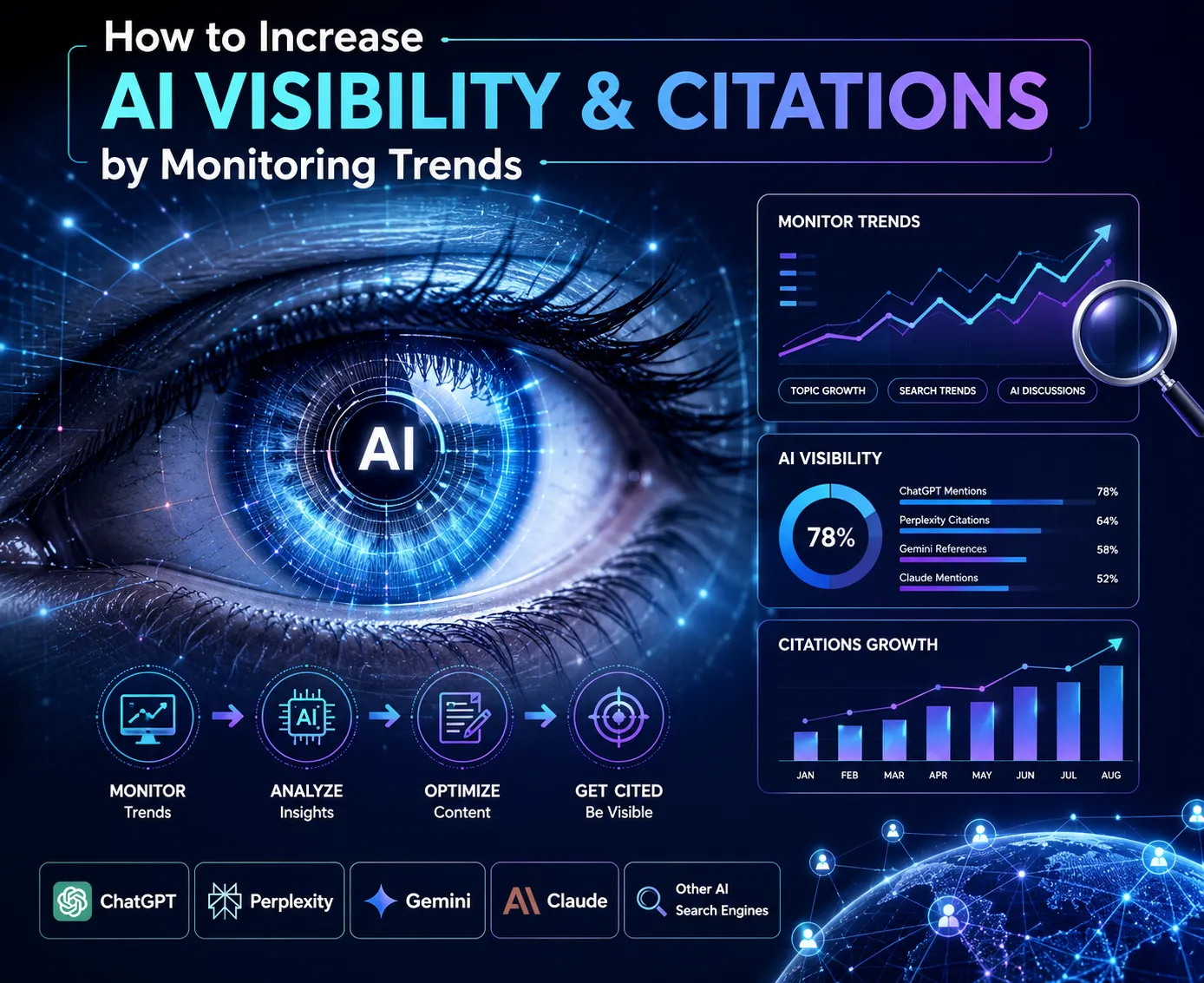
Are you still following the old content marketing strategies? Simply looking for website ranking and established keywords, and ignoring the AI platforms such as Gemini, Google AI Overviews, AI Visibility and Perplexity? Then it’s time to look forward and adapt to the trend that’s not going to stay, which is AI optimization.
You may have been missing out a lot just following the traditional SEO path, but today’s customers don’t care about ranking that much. That’s the reason you need to change this playbook and only that way you can win the hearts of your target audience with AI SEO optimization and visibility. But have you thought about how to achieve this success? It’s through tracking trends and creating best content proactively.
In this article, we will walk you through the right ways to monitor trends and augment your content strategies. At the end, it will help improve your chances of being cited and mentioned in AI-generated responses.
How to Use Trend Data to Publish Before Your Competitor Does
Every topic that becomes popular online follows the same strategy. It starts with a small number of readers, like you might have seen on forum posts, then it takes flight, as AI search picks it up and then it gets the best visibility ever.
If you’re planning to achieve that kind of success for your website, you have to post content in its early growth phase. Let’s take a look at the steps:
Step 1: Incoming Queries
Incoming queries are the first signal. This is the place where the search volume stays low, competition also remains almost nonexistent, and the topic hasn’t been covered too much.
This might seem like the hardest step to act on, but it’s also the most important and valuable one from where the content takes off because here you can establish a solid presence even when there’s tough competition in the marketplace.
Step 2: The Growth Section
This is the phase where the opportunity to dominate the conversion rate increases. Search volume is going up, but conversion is just a few steps away. This is the best spot for a lot of content teams.
Step 3: Peak on the Trend
This is the trend where everyone jumps on board with it. This can be higher competition, higher search volume and a search engine result page that is already filled with established content and has authoritative domains. Although, it’s crucial to understand that gaining citations isn’t possible in this stage, because it’s harder to fight when others have already claimed it.
Step 4: Decline of Trend
Decline of trend is the time when the topic already had its moment. Traffic will still come, but the trend line started to go down. Content published on the topic may start to have a short shelf life and is unlikely to become a strong source of citation in AI responses.
For instance, if you create content at peak, you’re already late. But if you create them during the growth phase, you have a shot with the AI responses. And creating content at the emerging level gives a better advancement.

Ways to Identify the Phase of Your Topic
There are some ways, using which you can identify which phase your content is. Let’s take a look:
Tools to Understand Trend Phases
You can easily take help of the SEMrush to check the keyword positions and volume trends over time for any given keyword. This will give you a quick overview on the topic’s standing.
If you want to grab the trendy topics at the emerging stage, use exploding topics that’s fit for more proactive research. These topics track millions of data across the web to display trends years and months before they go mainstream.
Here are the top features of the three exploding topics that are perfect for AI optimization and website content.
Trending Topics
Search the trends by filter and category by growth classification:
- Peaked (Ones that are already declining)
- Regular (Experiences a consistent growth)
- Exploding (A quick upward movement)
To build a better content strategy, you need to target regular and exploding trends before they reach the peak stage.
Trend Analysis
After spotting the potential subject, the analysis report allows you to comprehend the data, which includes related trends, platform coverage, search volumes and key indicators.
Trend Forecasting
If you find any relevant topic through the trend database, you will also receive a 12-month forecast, influenced by machine learning. You can use it to predict patterns in customer buying behaviors and help you determine which topic to go with.
The objective here is to get to the topic and publish content on it before your competitors claim it or SERP becomes too crowded, so you get improved citation.
How to Build Topical Authority with Emerging Subjects and Increase AI Visibility
To get AI citations, starting early on a potential topic and working with traditional SEO will not be enough, it will need depth. When Google generates an AI Overview, it goes through various subtopics and multiple sources instead of quoting the highest ranked link.
A single perfectly optimized webpage competes for the citations slots. But a topic cluster competes across many related sub-queries, which gives AI systems more reasons to cite your brand every time a query is made.
If you’ve already built strong topic clusters for traditional search engine optimization, you’ve already started. This is also the time when you create topic clusters around emerging trends.
The moment you identify an emerging trend using exploding topics, try not to publish content. Treat the trend as a topic domain and build a complete topical map.
How to Find Emerging Trends Relevant to Your Niche
If you’re ready to find that targeted content topic, go through this step-by-step workflow that includes AI visibility tools, keyword research and exploding topics data to identify the opportunities before your competitors do.
Step 1: Monitor and Analyze Trends That are Already Published
Start by adding exploding topics to the SEMrush account and you will get the topics from the app center menu. Move forward to the “Trends Database” section and select a category or find a subject that’s relevant to your brand.
For content strategy, use the growth filter and once you spot the trend that interests you. For traditional SEO competition use SEMrush keyword overview tool to add your trend as a keyword. If the subject you’re searching for is the latest, it may not have any result in the tool. But that’s fine; if it doesn’t show anything, move forward to the next step.
If you see some results, pay attention to two things:
The Number of Results Google Provides for the Query
Compare the topic against similar topics. When you get the lower numbers, you will know that the topic hasn’t been popular and you have the opportunity to use it in your content.
Authority Scores for the Highest Ranking Pages
If the webpages ranking comes from the sites you are unaware of, that’s a good signal that competition isn’t still strong. To check the AI visibility competition, open the “Prompt Research Report” inside SEMrush’s AI Visibility section.
Once you access the topic, check two numbers, “Source Domains,” and “Brands Mentioned.” Compare these across different prompts. When you get less numbers, it will give you a better chance to get cited.
Step 2: Content Planning and Creation
Once you have confirmed the emerging trendy topic with fewer competition in both AI and traditional search, it’s time to publish the content quickly. AI platforms will pick the content once it’s established. According to a 2026 study, only 14% of businesses only tracks AI citation visibility, even though 89% of companies are appearing in AI-generated responses.
This suggests, most of your competitors are showing up without a strong strategy, so you have the window open to build authority on the topic. But the opportunity narrows when you wait another month, and the moment your competitors earn consistent citations on a relevant topic, progressing on those trends becomes tough.
Start Tracking Trends before Your Competitors Do
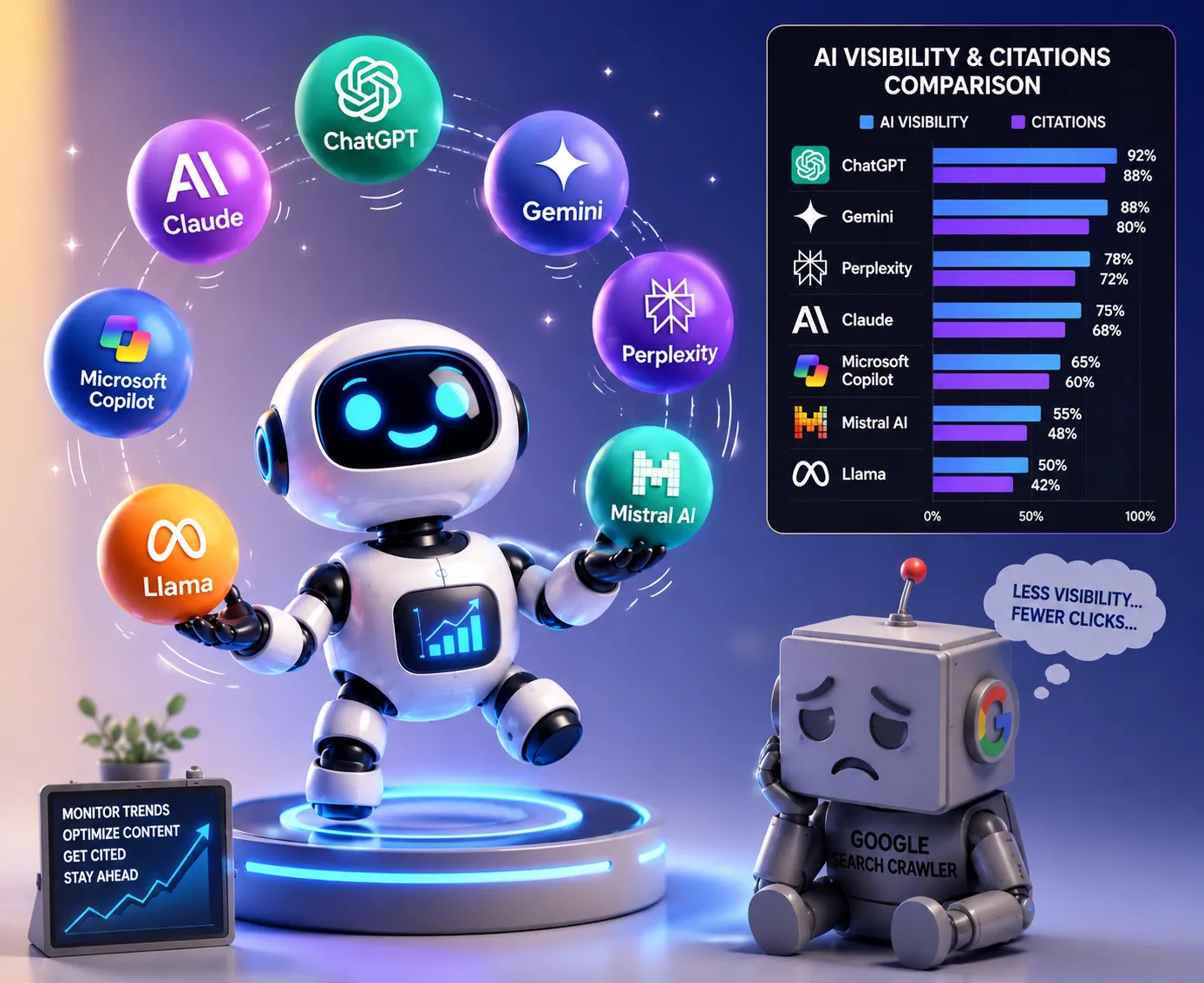
To get improved citation, try not to wait for topics to arrive at their peak stage before creating content on them. Publish earlier, research and build the topical authority AI SEO optimization that the AI systems such as Gemini, Perplexity, Claude, Google AI Overviews and Copilot identify and cite.
With exploding topics, you can create content that will definitely dominate early, earn AI visibility and receive better traffic and ROI for your business. And if you’re still feeling overwhelmed, One Design Marketing Technologies is there for you. Contact us today and join a team of digital marketing experts to get better growth for your brand.

FAQ
Is AI visibility similar to generative engine optimization (GEO)?
GEO and AI visibility may look alike but they’re not the same. Generative engine optimization refers to the optimization tactics that improve the presence of the brand. AI visibility on the other hand, is the process of tracking and measuring your company’s presence in AI responses. AI visibility can be the metric and GEO is the optimization process.
Can I track AI visibility without paying for anything?
Yes, you can test queries in AI platforms such as Gemini, Perplexity, Copilot and Google AI Overviews for free. However, free methods don’t give information about day-to-day fluctuations, geographic differences and other variations. Dedicated AI tools give comprehensive details that manual testing cannot provide.
Should I focus on traditional SEO when AI SEO optimization is more important?
Both are significant to get better visibility. Traditional search engine optimization allows your brand to stay at the top of search results and AI visibility cites your company whenever a customer posts a query. A top rank also improves the chance of your brand to be mentioned in the AI-generated result.
What’s the most popular AI platform for brand visibility?
For answer engine optimization (AEO), ChatGPT and Google AI Overviews are the most popular places. Optimize your content so it can be mentioned in these platforms.
How long do AI SEO services take to show results?
Most brands take 1 to 2 months to implement the AI SEO strategy. After that it might take 3 to 9 months to show the real results. However, complex requirements might take more time.
Will I get ChatGPT optimization if I hire an SEO company?
Yes. A reputed SEO service company will provide a comprehensive AI-powered search engine optimization, and ensure your website is cited and mentioned across all AI platforms.