
What is Search Engine Optimization? Guide to Beginner’s SEO
What’s the first thing you do when curiosity hits the back of your mind? Well, I share it with Google before it overpowers my brain cells and makes me pull out my hair. That’s exactly what search engines do; they help us discover places, people, products, services and lots more with a single click of a button.
And all this information comes from websites. But with hundreds of websites covering similar information, what are the odds that users will click on your website? What you may need is search engine optimization (SEO) to bring relevant visitors to your website. What else does SEO offer to online businesses? Here’s your guide to SEO for beginners.
What is SEO?
Search Engine Optimization (SEO) is the technique used by brands to improve their website’s visibility across search engines. A good SEO strategy helps businesses bring organic traffic, increase conversion rates, improve ROI and build domain authority over time.
SEO begins with using high-volume, relevant keywords in your website content so that when a user searches for those keywords, your website appears in the search results. However, for your website to rank higher on the SERPs, you need to make your website SEO-optimized.
Why is SEO Essential?
Here are the major benefits Search Engine Optimization offers to brands.
- Improves Search Visibility: SEO makes your website discoverable to your target audience searching for related queries.
- Brings Organic Traffic: SEO improves your website’s search visibility, thereby bringing more qualified traffic to your page.
- Generated Qualified Leads: SEO not only attracts more visitors but also helps convert them into successful buyers by pursuing them effectively.
- Builds Brand Credibility: A website with a Strong SEO strategy is highly trusted among both search engines and its visitors.
- Facilitates Long-Term Business Growth: While paid ads deliver quick results, SEO takes time to build organic visibility for your business, contributing to its long-term growth.
Understanding Working of Search Engines
To understand how modern-day SEO works, it’s essential for all businesses to first familiarize themselves with how search engines work.
- Crawling: When a user submits a query, search engines crawl through multiple website links, searching for recent content.
- Indexing: Search engines index information about the websites and pages listed in the SERPs.
- Ranking: Websites are then ranked on the basis of their content relevance and ease to understand, which determines how they rank across search engines.
What are Different Types of SEO
Let us now look into different types of search engine optimization techniques businesses can use to optimize their websites.
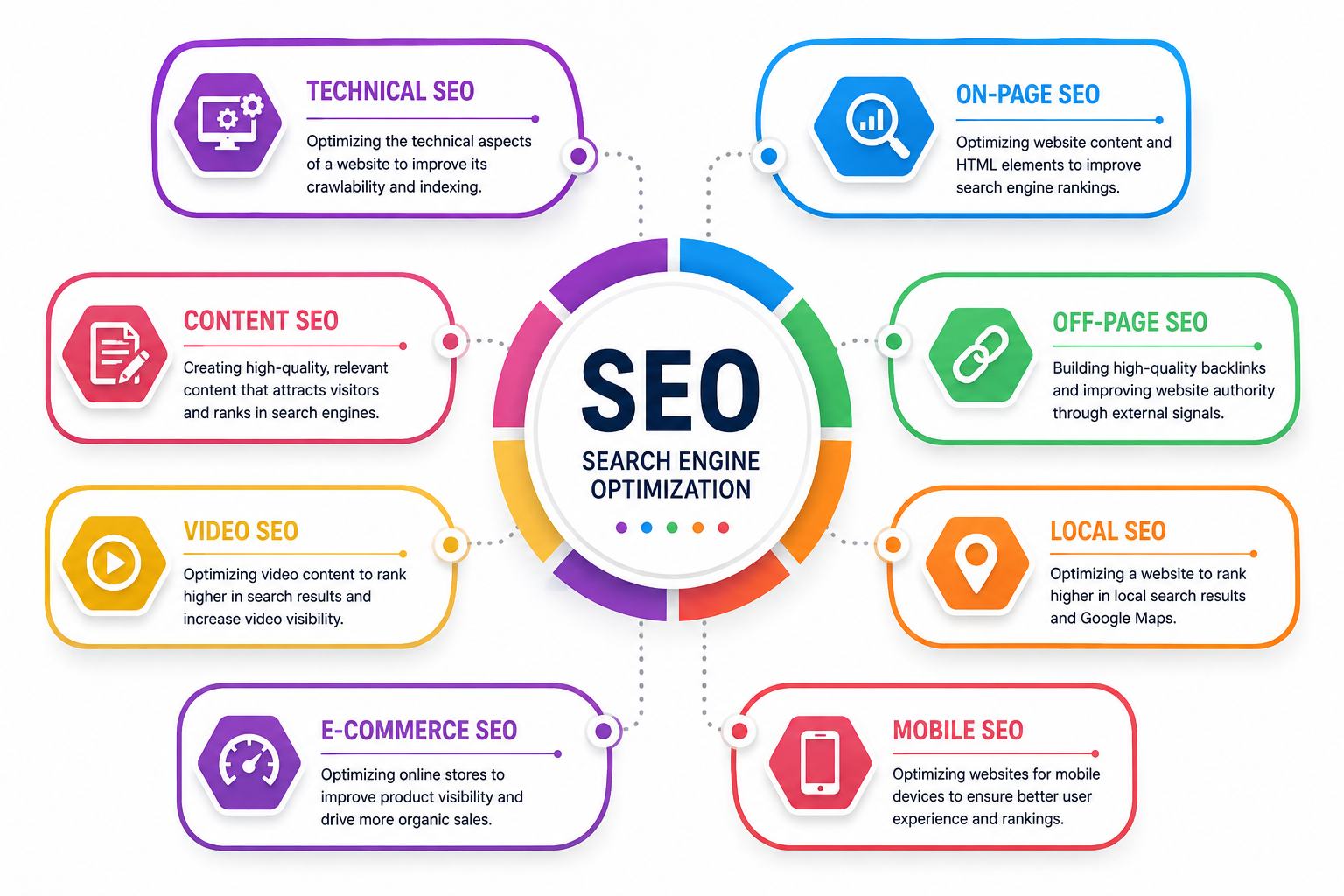
- On-Page SEO
Here, you optimize different elements of your website, such as titles, headings, meta descriptions, keywords, URL structure and internal links. Apart from these, every landing page is also optimized for content structure and quality along with images and alt text. This formatting helps search engines categorize information on your website easily.
- Off-Page SEO
It involves optimizing elements outside your website to influence its performance. It involves link building using trustworthy sources, brand mentions, content outreach, digital PR and relevant citations.
- Technical SEO
Technical SEO addresses issues related to your website speed, crawlability, broken links, XML sitemaps, indexing and even mobile accessibility, thereby making your website more accessible and understandable for search engines.
- Local SEO
Local businesses that wish to target specific geographic locations must go for local SEO-based keywords, such as ‘restaurants near me’ or ‘PPC services in the USA’, etc. You can boost local SEO using local keyword research, Google Business Profile optimization, location citations, location-based pages or content and online reviews.
- Content SEO
It is a form of SEO practice in which the website content is optimized to fulfil the user;s search intent. Adding high-ranking keywords is not enough. Your content must be clear, authentic, engaging, meaningful and organized logically.
- E-Commerce SEO
Want to make your products and services discoverable in your online store? Start with product keyword research, add product descriptions, fix technical SEO, add internal linking, fix website navigation and perform category & image optimization.
What is SEO Keyword Research & How to Perform it?
Keyword research simply means identifying those words or phrases that your target audience searches for online. It helps you understand the buying patterns and preferences of your potential buyers. While researching keywords, don’t just settle for their search volume. Also look out for their relevance, search intent and competition.
Following are the steps involved in search engine optimization keyword research:
- Decide on the subject: Find out about your primary product and service.
- Start with seed keywords: Identify basic keywords and phrases related to your subject.
- Search for related keywords: Look for more questions and terms related to your subject.
- Understand search intent: Check SERPs for websites ranking for the targeted keyword.
- Analyze competitors: Identify competitors for the targeted keywords and find gaps, if any.
- Generate keyword groups: Create groups of closely related keywords and use them across web pages.
One Design Marketing Technologies: Our SEO Strategy for Beginners
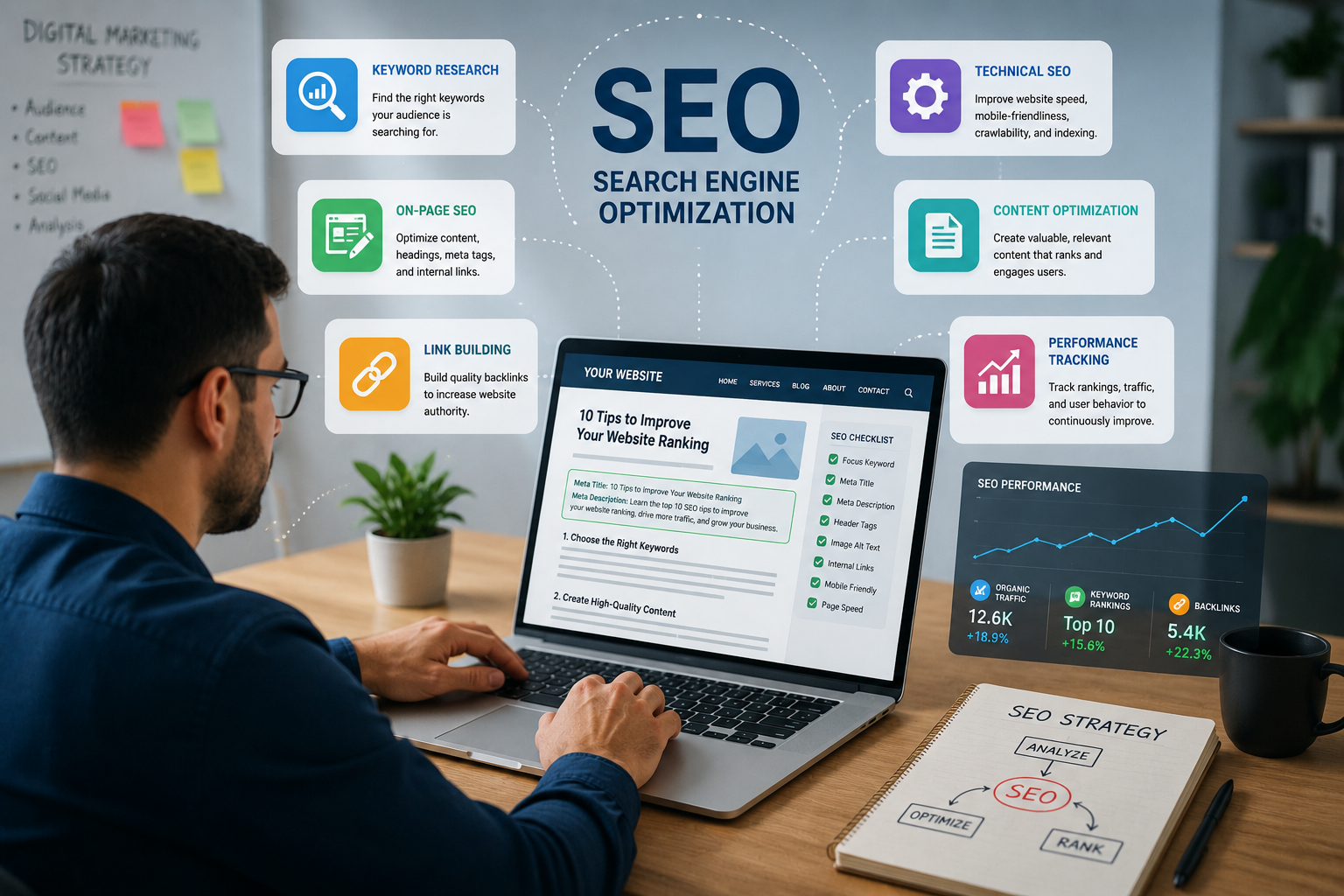
Here’s a simple roadmap we follow at ODMT to provide beginner’s SEO services to our clients:
- Understanding their target audience: Identifying the buying patterns, preferences and search queries of potential customers.
- Keyword research: Searching for relevant keywords related to your product offerings.
- Website auditing: Checking the quality of your website content, its loading speed, mobile friendliness, etc.
- Website optimization: Optimizing the existing website for on-page SEO elements.
- Creating new content: Adding relevant content to your website to capture audience interest.
- Building domain authority: Earning high-quality backlinks from relevant PR, outreach and partnership content.
- Tracking performance: Monitoring website search performance for traffic, conversion rate, ROI, etc.
- Continuous maintenance: Using performance data to improve our SEO strategy.
Final Words
Beginner’s SEO is more about understanding the changing market dynamics and restructuring your content to serve user intent. As you dive deeper into it, you must aim to enhance the overall user experience and build strong online authority.
With AI-powered answer engines and voice assistants taking over traditional search engines, traditional SEO strategies are just not enough to rank on the SERPs. Businesses now require AI-powered search engine optimization techniques to target both traditional as well as AI-driven search engines.
ODMT helps you restructure your website content according to the guidelines of Answer Engine Optimization (AEO) while keeping its original meaning and search intent. Whether you are a small startup new to the world of SEO or an MNC looking for advanced AI SEO services, our dedicated team of SEO experts is here to assist you 24/7. Connect with us today for a free quote or book an appointment now.
FAQs
-
What is the full form of SEO?
SEO stands for Search Engine Optimization. It is the process of optimizing a website’s content and technical aspects to boost its online search visibility and bring organic traffic.
-
Why do I need SEO for my website?
SEO can help attract organic traffic to your website and generate qualified leads by improving your online visibility and strengthening domain authority over the long run.
-
Is SEO free or paid?
SEO itself does not charge you anything per click from the users. However, you might have to pay SEO professionals for their SEO services. We, at ODMT, offer personalized and cost-effective AI SEO strategies, making SEO accessible even to small businesses.
-
What are different types of SEO?
SEO can be divided into the following major types— local SEO, technical SEO, on-page SEO, off-page SEO, e-commerce SEO and content SEO.
-
What are SEO keywords?
SEO keywords are phrases that you can include in your website content to target user queries on search engines. When users search for a particular keyword, search engines display a list of web pages featuring associated keywords.
-
How many keywords should I target in a page?
While there is no fixed number for that, you should focus on a single primary keyword and include its related secondary keywords in both long-tail and short-tail forms. Also, make sure to use all of these keywords naturally in the content without stuffing them.
-
How long does SEO take to show results?
Your SEO-optimized website might take anywhere between three to six months to show significant improvements. The results are largely influenced by factors such as content quality, technical SEO, website authority and market competition.
-
Should I go for SEO or paid ads?
If you are looking for organic traffic in the long run, SEO serves your purpose best. Paid advertising, on the other hand, offers paid visibility for a short period, until the campaign ends. You can use either of the two, or even both for an effective marketing strategy.
-
What is an SEO audit?
SEO audits help businesses evaluate the search performance of their website and look for any technical issues that might hinder its visibility and conversion rate across search engines.
-
Can AI replace SEO?
No, AI can never replace the need for SEO. In fact, ODMT combines the capabilities of AI with SEO to offer AI-powered search engine optimization strategies to its clients.
-
What is SEO analytics?
Performing SEO is not enough; you must measure its performance regularly to yield the best results. Website rankings are important but are not the only metrics you should care about. Also focus on organic traffic, impressions, CTR, backlinks, conversions, indexed pages, leads, engagement signals and revenue.
Explore Our Digital Marketing Services
Our Core Services
AI SEO Services
SEO by Location
SEO by Industry
Law Firm SEO Services
Healthcare SEO Services
Real Estate SEO Service
Dental SEO Services
Chiropractic SEO Services
HVAC SEO Services
Car Dealer SEO Services
Catering SEO Services
Fitness SEO Services
Gym Trainer SEO Services
Jewelry SEO Services
Limousine SEO Services
SEO for Luxury Travel
Insurance Agents SEO Services
Junk Removal SEO Services
Small Business SEO Services
Yoga Studio SEO Services