AI SEO of 2026: How GEO, SGE and EEAT are changing Google Rankings in the USA
The search engine system keeps evolving and traditional SEO isn’t the only factor that can give your brand the boost it deserves. In this digital era, AI SEO emerges as the new hero in the realm of efficient marketing strategies. Users today find the answer to their buying journey easily from the answers of AI Overview. The conversational tone of the artificial intelligence makes it easier to find the right solution for each query.
If you want to harness this power of AI, it’s important to understand how GEO, EEAT and SGE works for your website. With these when your target customers search for a relevant product and service, they will get a summary where your brand will be mentioned. This will enhance the click-through-rates and you will get more traffic and ROI.
In this blog, we have seen how GEO, SGE and EEAT influence Google rankings in the USA and how AI search is working. Let’s get into it.
Search Result Evolution in 2026
The way of searching results has changed from good keywords to answers from AI over the last few years. Nowadays people tend to ask complicated queries like “Which SEO agency provides the best AI SEO services in the USA?” instead of simple queries that they used to do in the past. The AI system of Google analyzes authority, context and intent to give a direct answer.
According to some Case studies, AI searches provide immediate responses and hence, there are less number of clicks to the web pages since the users get all the information from the search engine itself. Some other research says that CTR has fallen to 61% due to the popularity of AI Overviews.
Another study showed that 58% CTR falls once the AI-generated summary comes in the results of the search. This means better visibility in the AI answer and it has become more useful than normal rankings.
Understanding GEO, SGE, EEAT and More
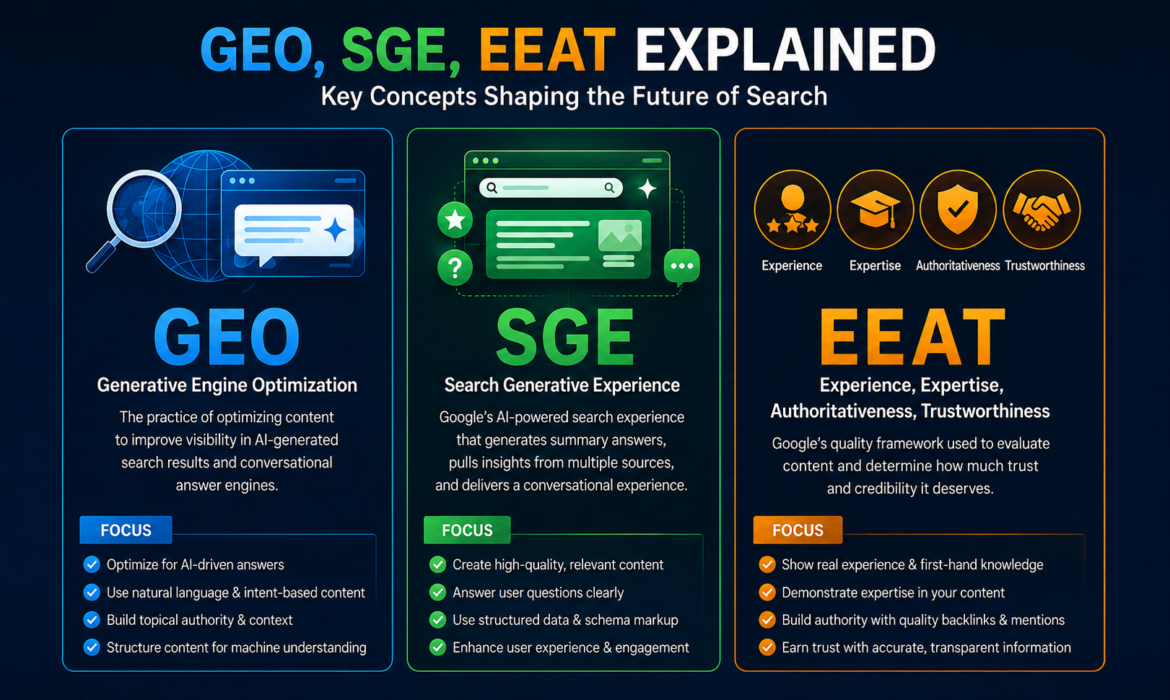
These are the key elements of AI SEO in the current digital world. The top-notch services use the power of GEO, SGE, and EEAT to give their clients a boost in ranking. Here are the brief descriptions of these platforms:
Generative Engine Optimization (GEO )
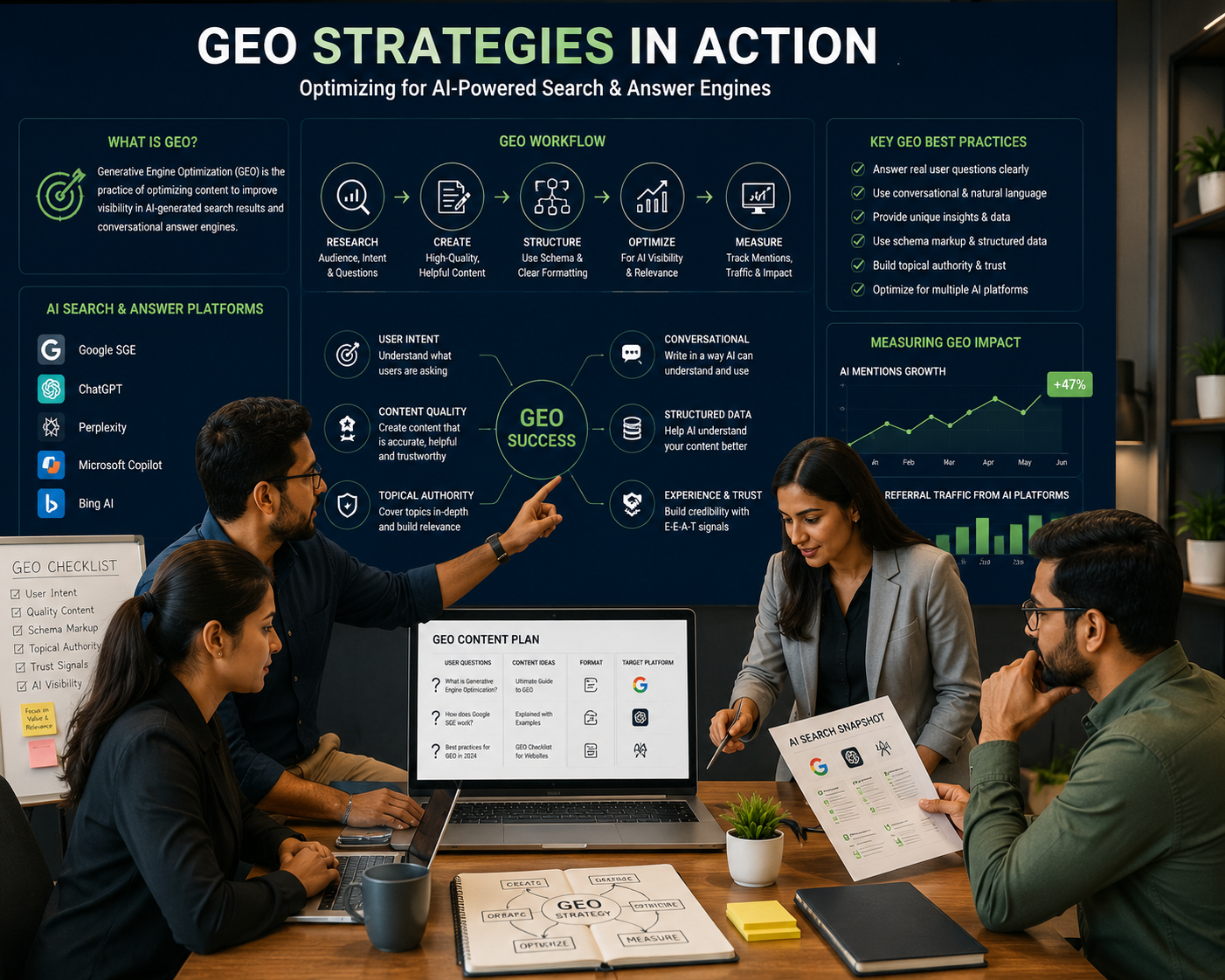
Generative Engine Optimization (GEO) means optimization of the content that requires citations from AI platforms such as Claude, Gemini, Perplexity, ChatGPT and Google AI Overviews. Search engine optimization helps to rank websites in order to appear higher in the search engine result page in the form of blue links. GEO, on the other hand, optimizes your website in such a way that it appears in the answer of AI.
The Latest Essential Part of GEO
GEO is the latest and an essential part of AI SEO. The study by Georgia Tech Research and Princeton University reveals that AI SEO strategies enhance visibility and reactions up to 40%. It is also important to know that Generative Engine Optimization is not an alternative to regular SEO. It provides an additional level. The brands that perform well in terms of GEO in 2026 are the ones with a strong foundation of SEO. Furthermore, it provides citations, structure and data richness that SEO doesn’t provide.
Answer Engine Optimization (AEO)
Answer Engine Optimization (AEO) is a technique of providing answers to certain questions in an AI-friendly way. AEO was initially used to optimize the results of voice searches; however, it gradually became applicable to other types of AI-generated answers, such as Featured Snippets and Google AI Overviews.
The main concept behind AEO is providing an exact answer to a given question, which will be comprehensive enough to contain all the details needed in one or two sentences. The content provided by AI contains answers that do not need any further explanation to be understood.
AI-Assisted Traditional SEO
AI technology is changing the face of traditional SEO. Using AI technologies, companies can receive top-performing keywords in just a few hours, instead of days. Content gap analysis has been automated to the extent that there is no need for a manual review. Technical SEO audits could only be performed by specialists; however, nowadays, they can be done using AI technologies.
The core idea of this is that the tasks which consumed much time are now performed in just a few minutes. The AI tools manage the automation of these processes, and people get to focus on creative processes and strategy development.
Search Generative Experience (SGE)
The revolutionary change in the realm of AI SEO is Search Generative Experience (SGE) as it transforms the interaction of users with the search results. With the use of SGE, users can get the summary of what they are searching for, and there are links to the credible sources which they need. There is no need to spend many hours on finding the right products on Google search results anymore.
Businesses who want their brand mentions in AI summaries must build authority with improved site optimization so Google understands and recognizes their content, not just to rank it but to display it in the answers. Working with a reputed SEO company can help you achieve that authority in AI SEO and shape how your brand is visible on the internet.
EEAT Signals
Google’s EEAT framework (Experience, Expertise, Authoritativeness and Trustworthiness) is a significant part of AI-generated content. The search engine needs signals that distinguish useful content from AI fluff, and EEAT ensures that distinction is done properly.
Practical EEAT signals include case studies, first-person experience, original research and data, author bios with verified credentials, a proper company identity, expert quotes and citations.
How AI Search Systems Work
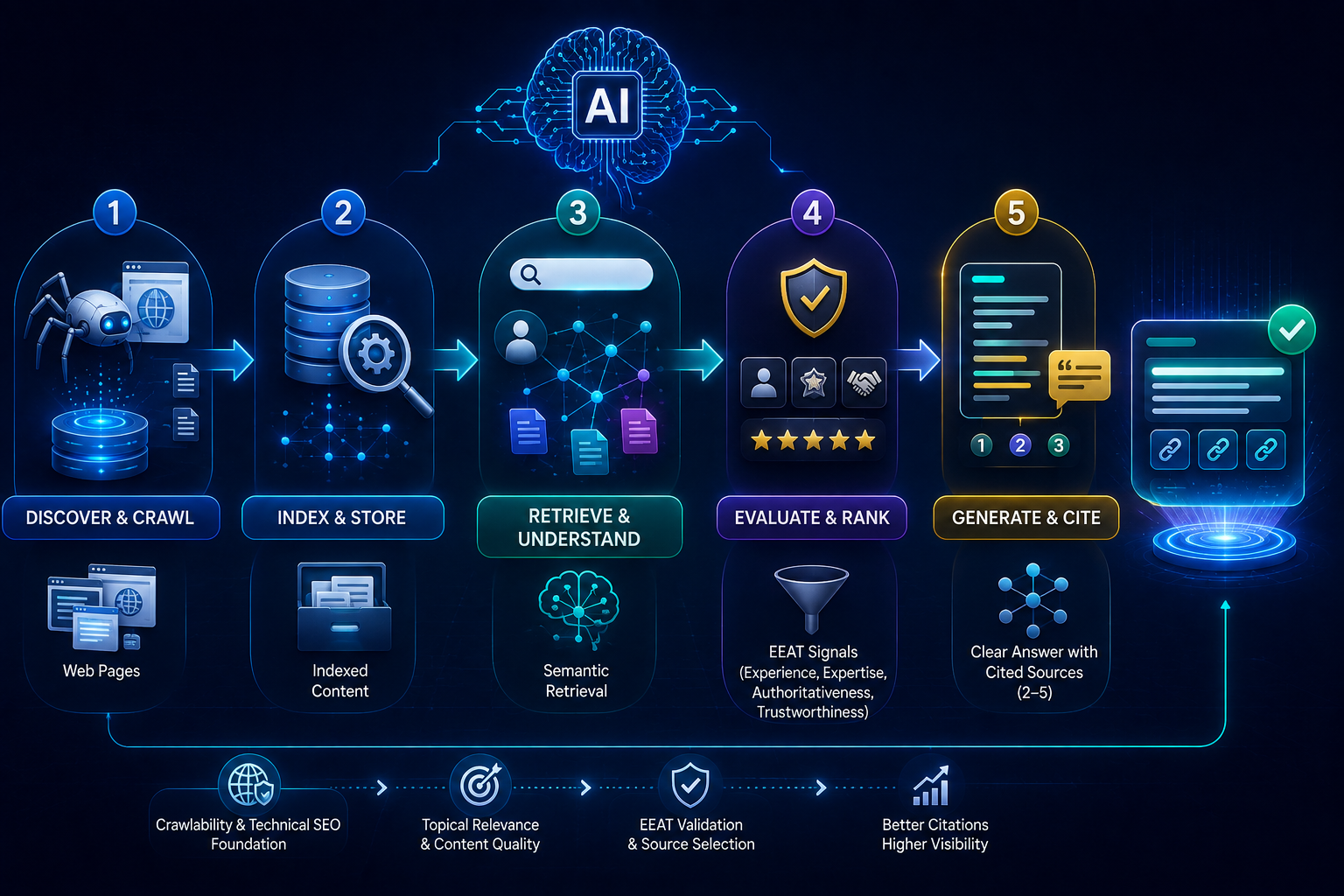
Planning to optimize your brand website for AI search? Before you do, it’s crucial to understand how AI systems retrieve and cite content. Most production technologies use a Retrieval-Augmented Generation (RAG) pipeline.
Crawling and Indexing
AI search systems and index web content, similar to traditional search engines. If your site cannot be crawled, it will not get indexed and AI platforms cannot cite it. This makes for technical SEO, sitemap submission, page speed, robots.txt and crawlability a primary requirement for AI SEO.
Semantic Retrieval
When a user submits a query online, the AI system selects the most semantically relevant passages across indexed content. This isn’t keyword matching, but understanding the meaning of the query and the content. AI systems look for better alignment, relevance and topical depth with user intent.
The EEAT signals check the relevancy of the sources. It goes through the demonstrated experience, corroborating authority, explicit expertise and consistent trustworthiness. The system then selects two to five sources to cite to the user, and it provides direct and citable replies only with clear structure.
Answer Generation and Citation Selection
The AI models select information from sources that offer a coherent answer. The sources it cites that offer the best authority, have a clear structure and are directly relevant to the specific user question. The selection of two to five cited sources is the result of GEO efforts.
The Island Test
This is the most important GEO concept, the Island Test drawn from Princeton-led GEO research. It addresses how AI systems select content. Passages that are semantically complete and can stand alone without context from other text provide clearer embeddings and align with user queries perfectly.
This suggests that every paragraph and every section of the content must answer a question without the reader needing to have read what was before it. If a passage starts with “as mentioned before,” it fails the Island test. It only passes the answers that open with a direct and complete approach.
SEO companies perform this text with site content to test whether it could stand alone as a useful answer to a query. If it fails, they restructure it until it passes the test.
Final Thoughts
Traditional metrics such as rankings and traffic aren’t enough. Businesses in the USA are now focusing on essential KPIs that include brand mentions, conversion rates from organic search, AI Overview citations, engagement metrics and AI answers.
Google AI search features are shifting how information is discovered online by buyers. AI Overviews provide direct and immediate answers and that’s why the SEO system is evolving into AI optimization.
To get better SEO success in 2026, your business, whether it’s in the US or any other part of the world, must focus on authority-based content, optimize for AI summaries, maintain strong technical SEO and build brand credibility across search engines.
Looking for a reputed SEO company? Let One Design Marketing Technologies help you in your success journey. Work with the best team and create trustworthy, AI-readable and structured content.
FAQ
How can brands improve visibility in AI-generated search results?
Brands can achieve it by creating well-structured and conversational content that directly answers user questions. Improved authority and consistency across digital platforms also helps AI engines understand credible sources.
What’s the difference between generative engine optimization (GEO) and traditional SEO?
Regular or traditional SEO focuses on improving website ranking on the search engine results. GEO, on the other hand, concentrates on helping AI systems identify and mention trustworthy sites in its responses.
How do AI-powered search engines determine which content to suggest to the users?
AI engines evaluate the authority, expertise, relevance and trustworthiness of content. They also consider consistency of information across brand mentions, platforms and sites.
How do I prepare my business for the future of AI-powered search?
To make your business future-ready for AI searches, you need to build strong topical authority and publish unique and updated content. Maintaining consistency across multiple platforms helps improve long-term visibility on AI results.
What schema markup is crucial for AI SEO?
FAQ page schema is the highest-impact schema type for generative engine optimization, because it structures your content perfectly. Article schema with genuine author and data markup establishes content authorship and uniqueness.
What’s the difference between GSO, AEO and GEO?
Generative engine optimization (GEO) refers to the practice of optimizing content for AI-generated answers. Answer engine optimization (AEO) focuses on formatting content to be pulled into single-answer responses. Generative search optimization (GSO) is used interchangeably with GEO, though some SEO services use it to describe optimization processes for a specific AI platform.
Should a brand handle AI SEO in-house or join an SEO company?
Many businesses start with in-house, but AI SEO strategy requires ongoing monitoring of the way LLM SEO signals changes across platforms such as Google’s AI Overviews, Perplexity, Gemini and ChatGPT. A specialized SEO company offering industry-approved AI SEO typically has the advanced tools and experience to track these shifts and create content accordingly better than an in-house team.
How does ChatGPT optimization differ from SGE optimization?
ChatGPT optimization relies heavily on training citation-worthy content and data patterns. Optimizing for search generative experience, on the other hand, is closer to regular SEO combined with structured data. Google’s system draws content from its live index and existing ranking list.
Do PPC services fit into an AI-powered engine optimization strategy?
PPC services drive instant visibility through paid placements; they also generate valuable data that helps users. Businesses can use those insights back into their AI SEO strategies, creating organic content so it matches the same high-intent language that performs well in paid campaigns.
Why does SXO matter for AI SEO?
Search experience optimization (SXO) combines search engine optimization with buyer journey factors such as easy navigation, content clarity and page speed. AI-powered optimization ranks content that offers user satisfied clicks, since the engagement signals help AI systems source reliable answers, strengthening its credibility for future citations.
Explore Our Digital Marketing Services
Our Core Services
AI SEO Services
SEO by Location
SEO by Industry
Law Firm SEO Services
Healthcare SEO Services
Real Estate SEO Service
Dental SEO Services
Chiropractic SEO Services
HVAC SEO Services
Car Dealer SEO Services
Catering SEO Services
Fitness SEO Services
Gym Trainer SEO Services
Jewelry SEO Services
Limousine SEO Services
SEO for Luxury Travel
Insurance Agents SEO Services
Junk Removal SEO Services
Small Business SEO Services
Yoga Studio SEO Services